
When someone searches “plumber near me,” “Dubai AC repair,” or “emergency electrician in Miami,” they are telling you what they need. Keyword categories help you organize those searches into clear groups.
For a home services business, this makes SEO easier. Instead of chasing hundreds of random phrases, you can group similar searches by intent, service, location, audience, and buying stage.
What Are Keyword Categories?
Keyword categories are groups of related search terms that share a common topic, purpose, or search intent.
For example, a plumbing company could group keywords like this:
- Service: plumbing repair
- Problem: leaking pipe repair
- Location: plumber in Houston
- Urgency: emergency plumber
- Price: plumbing repair cost
- Commercial: commercial plumbing services
- Local: plumber near me
- Informational: how to fix a leaking faucet
Think of keyword categories like drawers in a toolbox. Each drawer holds a different type of tool. You could throw everything into one box, but finding what you need would take longer.
Why Do Keyword Categories Matter for SEO?
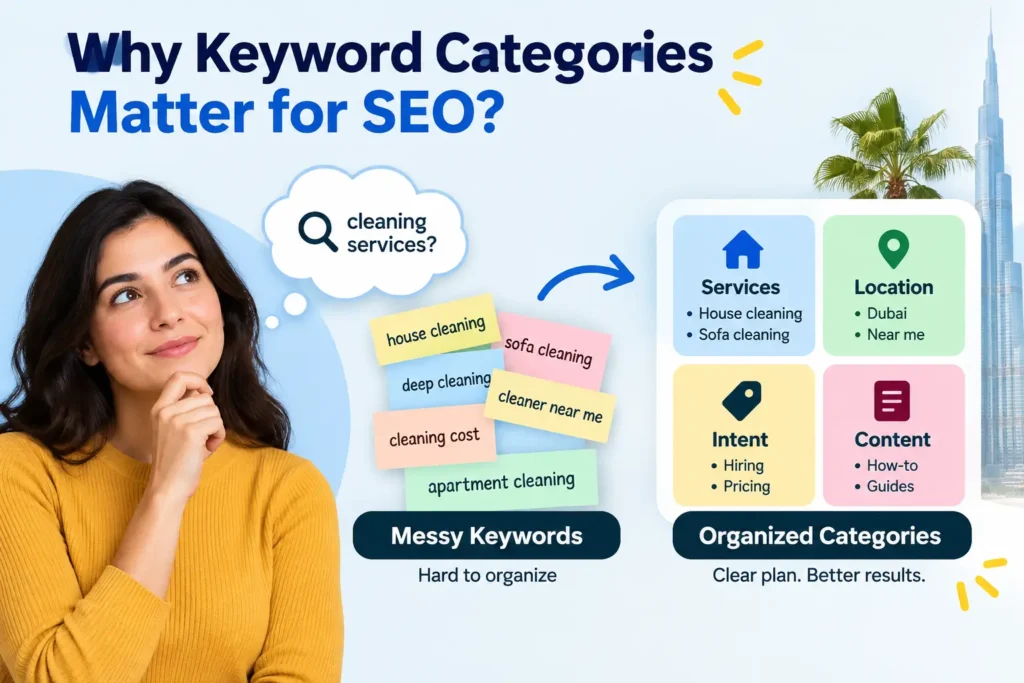
Keyword categories turn a messy keyword list into a useful content plan.
Imagine a Dubai cleaning company has these keywords:
- house cleaning Dubai
- sofa cleaning Dubai
- deep cleaning Dubai
- apartment cleaning Dubai
- cleaning company Dubai
- move out cleaning Dubai
- how much does deep cleaning cost
- cleaner near me
These phrases are related, but they do not all mean the same thing.
Someone searching “how much does deep cleaning cost” is looking for pricing information.
Someone searching “deep cleaning company Dubai” may be ready to hire.
Someone searching “how to deep clean an apartment” may want instructions.
Putting all of these keywords on one page can create a confusing page.
Grouping them first gives each search a logical home.
Keyword Categories Help You Match Search Intent
Search intent means the reason behind a search.
A simple way to think about it is:
What does the person actually want to do next?
For home services, that might be:
| Search | Likely intent | Useful page |
|---|---|---|
| plumber near me | Local/service | Plumbing service page |
| emergency plumber Dallas | Local + transactional | Emergency plumbing page |
| leaking pipe repair cost | Commercial/informational | Cost guide |
| how to unclog a sink | Informational | Blog/how-to |
| ABC Plumbing | Navigational | Brand page |
| best HVAC company Phoenix | Commercial research | Comparison/service guide |
| AC repair Dubai | Local + transactional | AC repair page |
| AC cleaning cost Dubai | Commercial | Pricing guide |
Google says its systems can understand related language and different ways people search for the same topic. You do not need to force every variation onto a page.
The Main Types of Keyword Categories
The easiest way to understand keyword categories is to look at them by purpose.
1. Seed Keywords
Seed keywords are broad starting terms.
They are usually short and describe the main business, product, or service.
For a home services company, examples include:
- plumber
- electrician
- HVAC
- roofing
- cleaning
- pest control
- handyman
- landscaping
A seed keyword is like the trunk of a tree.
More specific keywords grow from it.
Example
Seed keyword:
plumbing
Related categories could include:
- plumbing services
- plumbing repair
- emergency plumbing
- residential plumbing
- commercial plumbing
- plumbing contractor
- plumbing company
- plumbing cost
- plumber near me
2. Primary Keywords
A primary keyword is the main phrase a page is built around.
For example, a plumbing service page might target:
plumbing services in Houston
An AC repair page in the UAE might target:
AC repair Dubai
The primary keyword should describe the page naturally.
Do not repeat it in every sentence.
Google specifically warns against keyword stuffing, which means excessively repeating keywords to manipulate search visibility.
3. Secondary Keywords
Secondary keywords are closely related terms that support the main topic.
For an AC repair Dubai page, examples could include:
- air conditioner repair Dubai
- AC technician Dubai
- air conditioning repair
- split AC repair
- central AC repair
- AC maintenance Dubai
- emergency AC repair
These terms help explain the subject more fully.
4. Long-Tail Keywords
Long-tail keywords are usually more specific search phrases.
Examples:
- emergency plumber for burst pipe in Houston
- residential AC repair in Dubai Marina
- move out cleaning service in Abu Dhabi
- same day electrician near me
- roof leak repair cost in Florida
Long-tail searches can reveal exactly what the customer needs.
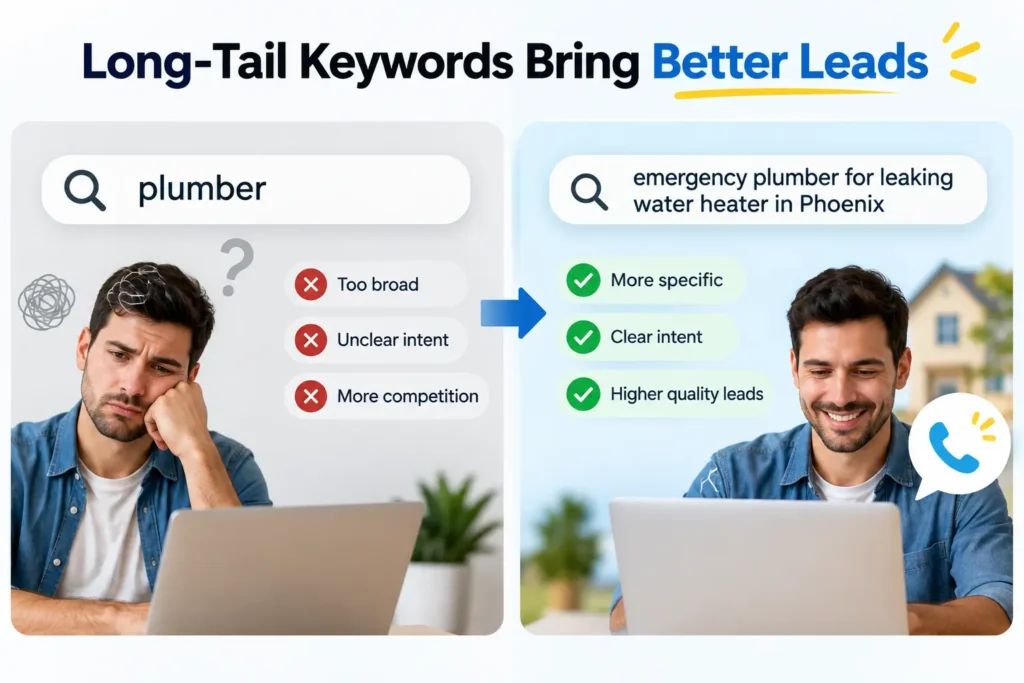
Compare:
“plumber”
with:
“emergency plumber for leaking water heater in Phoenix”
The second search gives a home service company much more information.
5. Short-Tail Keywords
Short-tail keywords are broad phrases, often containing one or two main words.
Examples:
- plumber
- roofing
- cleaning service
- pest control
- AC repair
They can describe a large topic but may not show exactly what the searcher wants.
Use them as category starters rather than building your entire strategy around them.
Local Keyword Categories
Local keywords are especially important for home services.
A homeowner in Miami does not usually want a plumber in Seattle. A resident of Dubai does not want an AC technician in Abu Dhabi unless they are willing to travel.
Local Keywords
Local keywords include a city, neighborhood, ZIP code, district, or phrase such as “near me.”
Examples from the USA:
- plumber in Houston
- electrician Miami
- HVAC contractor Phoenix
- roof repair Austin
- pest control Orlando
- handyman near me
Examples from the UAE:
- plumber Dubai
- AC repair Dubai
- cleaning company Abu Dhabi
- pest control Sharjah
- electrician Ajman
- handyman Dubai Marina
Google notes that search results can vary based on factors such as location, language, and device.
Geo-Modified Keywords
A geo-modified keyword combines a service with a specific place.
Examples:
USA
- Dallas plumbing services
- roof repair in Tampa
- HVAC repair in Las Vegas
- house cleaning in Chicago
UAE
- AC maintenance Dubai
- plumbing services Abu Dhabi
- villa cleaning Dubai
- pest control Sharjah
These keywords are useful when a business serves specific locations.
“Near Me” Keywords
“Near me” searches are another useful category.
Examples:
- plumber near me
- electrician near me
- house cleaning near me
- HVAC repair near me
Do not create dozens of pages such as “plumber near me Miami,” “plumber near me Houston,” and so on just to repeat the phrase.
Build useful local pages around real service areas instead.
Search Intent Keyword Categories
Search intent is one of the most useful ways to organize keywords.
Informational Keywords
Informational searches are usually about learning something.
Examples:
- how to unclog a drain
- how often should AC filters be changed
- how to prepare a house for pest control
- what causes low water pressure
- how often should a roof be inspected
These searches are often good for blog posts, guides, FAQs, and educational content.
Commercial Investigation Keywords
These searches happen when someone is researching options before making a decision.
Examples:
- best HVAC company in Phoenix
- AC repair vs replacement Dubai
- best pest control company in Miami
- professional cleaning vs DIY cleaning
- plumbing repair cost Houston
The searcher may not be ready to call yet.
They are comparing choices.
Transactional Keywords
Transactional keywords show stronger action intent.
Examples:
- hire a plumber Houston
- book AC repair Dubai
- emergency electrician Miami
- schedule house cleaning Abu Dhabi
- roof repair service Austin
These keywords often belong on service or landing pages.
Navigational Keywords
Navigational searches usually involve a specific business or website.
Examples:
- ABC Plumbing Houston
- XYZ AC Dubai
- Home Depot
- ServiceMaster
- company phone number
- company address
The user already has a destination in mind.
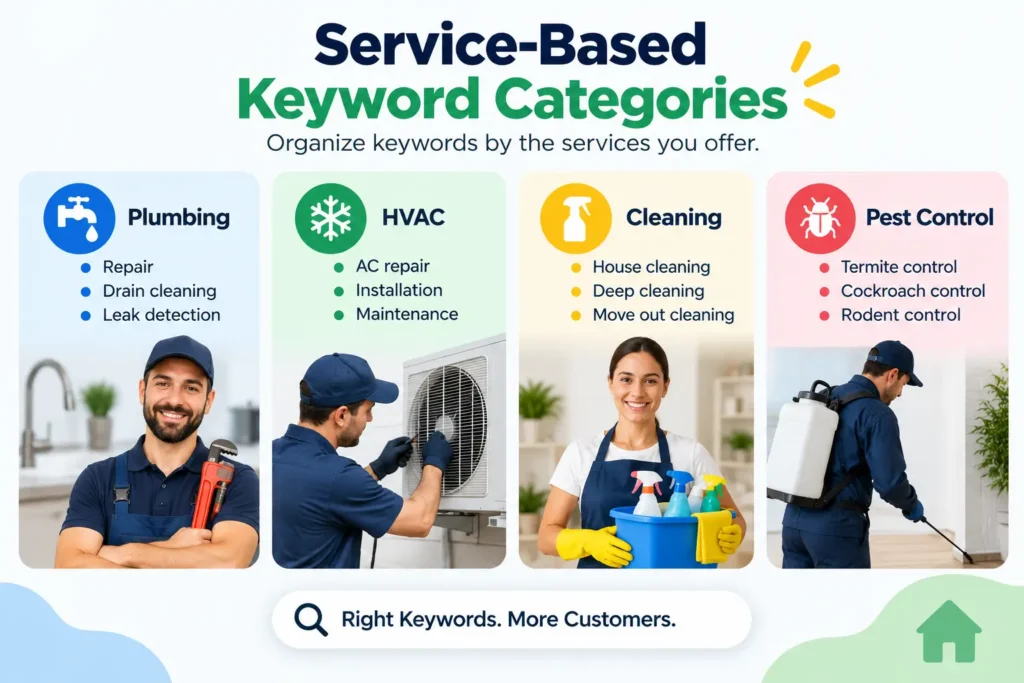
Service-Based Keyword Categories
Home services have another useful grouping method: the actual service.
Plumbing Keywords
Common categories include:
- plumbing services
- plumbing repair
- drain cleaning
- leak detection
- water heater repair
- sewer line repair
- pipe repair
- emergency plumber
- bathroom plumbing
- kitchen plumbing
USA example:
emergency plumber in Dallas
UAE example:
plumbing repair Dubai Marina
HVAC Keywords
HVAC stands for heating, ventilation, and air conditioning.
Common categories include:
- AC repair
- AC installation
- HVAC repair
- HVAC maintenance
- air conditioning service
- furnace repair
- heat pump repair
- duct cleaning
- thermostat repair
In the UAE, AC-related searches are especially relevant because cooling is a major home comfort need.
Examples include:
- AC repair Dubai
- split AC repair Dubai
- central AC maintenance Dubai
- AC technician Abu Dhabi
Cleaning Service Keywords
Cleaning businesses can create groups such as:
- house cleaning
- deep cleaning
- apartment cleaning
- office cleaning
- move out cleaning
- carpet cleaning
- sofa cleaning
- window cleaning
- maid service
- post-construction cleaning
USA example:
move-out cleaning service in Houston
UAE example:
deep cleaning company Dubai
Pest Control Keywords
A pest control business could organize keywords around the pest.
For example:
- pest control
- termite control
- cockroach control
- bed bug treatment
- mosquito control
- rodent control
- ant control
- spider control
Then add location and intent:
- termite control Miami
- bed bug treatment Dubai
- pest control Abu Dhabi
- cockroach control Sharjah
This creates a clean keyword structure.
Problem-Based Keyword Categories
Problem keywords focus on what has gone wrong.
They are powerful because people often search for the problem before they search for the service.
Common Home Service Problems
Examples include:
- leaking faucet
- clogged drain
- broken water heater
- AC not cooling
- AC making noise
- toilet overflowing
- low water pressure
- roof leaking
- clogged air filter
- pest infestation
- broken light switch
Consider the difference:
Service keyword:
AC repair Dubai
Problem keyword:
AC not cooling Dubai
The second phrase tells you what the customer is experiencing.
That can make the page more useful because you can explain the symptoms, possible causes, repair options, and when to call a technician.
Question Keyword Categories
Question keywords are natural language searches.
They often begin with:
- what
- why
- how
- when
- where
- can
- should
- is
- does
Examples:
- Why is my AC not cooling?
- How much does plumbing repair cost?
- When should I replace my water heater?
- Can a plumber fix low water pressure?
- Is pest control safe for pets?
- How often should I clean my AC?
These are excellent sources for FAQ sections and informational content.
Branded and Non-Branded Keywords
A branded keyword includes a company or brand name.
Example:
ABC Plumbing Houston
A non-branded keyword does not.
Example:
plumbing company Houston
Both can matter, but they serve different purposes.
Branded searches usually indicate that someone already knows the business.
Non-branded searches can introduce a company to people who are still looking for a provider.
Seasonal Keyword Categories
Some services have seasonal demand.
Examples include:
- AC maintenance before summer
- furnace repair before winter
- storm damage roof repair
- holiday deep cleaning
- mosquito control summer
- pool maintenance summer
For the UAE, seasonal patterns can differ from the USA.
A Dubai business might build content around:
- AC maintenance before peak summer
- villa deep cleaning
- moving cleaning
- pest control
- water tank cleaning
The key is to match content to the actual service area and customer behavior.
Negative Keyword Categories
Negative keywords are mainly associated with paid search.
They tell an advertising platform which searches should not trigger an ad.
For example, a professional plumber may not offer training courses.
Potential negative terms could include:
- plumbing jobs
- plumbing career
- plumbing school
- plumbing course
- DIY plumbing
Google Ads supports broad, phrase, and exact keyword match types, along with negative keyword options.
Negative keywords are different from normal SEO keyword categories because their purpose is exclusion rather than content targeting.
Semantic and Related Keyword Categories
Semantic keywords are words and concepts closely connected to the main topic.
Suppose the main keyword is:
water heater repair
Related terms may include:
- hot water
- thermostat
- heating element
- tank
- pressure relief valve
- water heater installation
- gas water heater
- electric water heater
- leaking water heater
You do not need to insert all of these terms into one paragraph.
Instead, cover the topic naturally.
Google says its language systems can understand how pages relate to different queries, even when the exact search wording is not present.
How to Create Keyword Categories Step by Step
Keyword research becomes much easier when you use a repeatable process.
Step 1: Start With Your Core Services
Write down everything the business actually offers.
For a home services company:
- plumbing
- electrical
- HVAC
- cleaning
- pest control
- roofing
- handyman
- landscaping
Do not start with hundreds of keywords.
Start with the real services.
Step 2: Add Customer Problems
Think like a homeowner.
Ask:
“What would make someone call this business today?”
For a plumber:
- burst pipe
- clogged drain
- leaking faucet
- low water pressure
- broken water heater
For an HVAC company:
- AC not cooling
- strange AC noise
- bad smell from AC
- high energy bill
- broken thermostat
Step 3: Add Location
Now add the areas the business actually serves.
For example:
USA
- plumbing Houston
- plumbing Katy
- plumbing Sugar Land
UAE
- plumbing Dubai
- plumbing Jumeirah
- plumbing Dubai Marina
Do not claim service areas that the company does not cover.
Step 4: Add Search Intent
Label each keyword:
- Informational
- Commercial
- Transactional
- Navigational
- Local
This simple step can prevent a lot of bad content planning.
Step 5: Group Similar Keywords
Put closely related phrases together.
For example:
AC repair Dubai
- AC repair Dubai
- air conditioner repair Dubai
- AC technician Dubai
- AC service Dubai
- AC not cooling Dubai
Then create a page that genuinely answers those related needs.
Step 6: Assign Keywords to Pages
A simple keyword map might look like this:
| Page | Primary keyword | Supporting categories |
|---|---|---|
| Homepage | home services company Dubai | home maintenance, local services |
| Plumbing page | plumbing services Dubai | leak repair, drain cleaning |
| AC page | AC repair Dubai | AC technician, AC maintenance |
| Cleaning page | cleaning services Dubai | deep cleaning, apartment cleaning |
| Blog | AC not cooling | causes, troubleshooting, repair |
| Pricing guide | AC repair cost Dubai | service cost, replacement cost |
This prevents several pages from fighting for the same topic.
Keyword Categories for USA Home Services
A US home services website often needs strong service and location combinations.
For example, a Houston plumbing company could organize its keywords into:
| Category | Examples |
|---|---|
| Core service | plumbing services Houston |
| Emergency | emergency plumber Houston |
| Problem | burst pipe repair Houston |
| Local | plumber near me |
| Price | plumbing repair cost |
| Residential | residential plumber Houston |
| Commercial | commercial plumbing Houston |
| Informational | how to unclog a drain |
| Service | water heater repair Houston |
A roofing company in Florida could use:
- roof repair Florida
- roof replacement
- storm damage roof repair
- roof inspection
- leaking roof repair
- commercial roofing
- residential roofing
- emergency roof repair
Keyword Categories for UAE Home Services
UAE home services need strong location signals because services are often tied to specific cities and communities.
A Dubai home maintenance company could group keywords into:
| Category | Examples |
|---|---|
| Service | home maintenance Dubai |
| Plumbing | plumber Dubai |
| AC | AC repair Dubai |
| Cleaning | deep cleaning Dubai |
| Pest control | pest control Dubai |
| Location | home maintenance Jumeirah |
| Property | villa maintenance Dubai |
| Problem | AC not cooling Dubai |
| Price | AC repair cost Dubai |
| Emergency | emergency plumber Dubai |
For Abu Dhabi:
- plumber Abu Dhabi
- AC repair Abu Dhabi
- villa cleaning Abu Dhabi
- pest control Abu Dhabi
- handyman Abu Dhabi
- electrical repair Abu Dhabi
For Sharjah:
- plumbing services Sharjah
- AC maintenance Sharjah
- pest control Sharjah
- cleaning company Sharjah
The same framework works across UAE cities, but the actual service area should match the business.
Common Keyword Research Mistakes
Keyword research can go wrong even when the keyword list looks impressive.
Mistake 1: Choosing Keywords Only by Search Volume
A keyword with lots of searches is not automatically useful.
A local plumber may get little value from a huge keyword such as:
plumbing
A more specific phrase such as:
emergency plumber Houston
may be much closer to the business’s actual customer.
Mistake 2: Creating a Page for Every Tiny Variation
You do not need separate pages for:
- plumber Houston
- Houston plumber
- plumbers Houston
- plumbing Houston TX
- plumbing company Houston
If the search intent is essentially the same, one strong page may serve the topic better.
Mistake 3: Ignoring Customer Problems
People do not always search for a service name.
They may search:
Why is my AC blowing warm air?
That question can become a useful article that explains when professional repair is needed.
Mistake 4: Stuffing Keywords Into Content
Repeating:
AC repair Dubai, AC repair Dubai, AC repair Dubai
does not make a page better.
It makes the writing uncomfortable.
Google explicitly advises against excessive keyword repetition and says keyword stuffing violates its spam policies.
Mistake 5: Mixing Different Intent on One Page
A page about “how to fix a leaking faucet” should not suddenly become a sales page for every plumbing service.
Give the reader what they came for.
Then provide a natural next step if professional help is needed.
Keyword Category Checklist
Before publishing a page, check:
- Does the keyword match the actual service?
- Is the search intent clear?
- Is the location accurate?
- Are related terms included naturally?
- Does the page answer the main question quickly?
- Are customer problems covered?
- Is the page useful without keyword repetition?
- Does the title clearly describe the page?
- Does the page have useful internal links?
- Are service areas genuine?
- Are FAQs based on real customer questions?
- Are images relevant and properly described?
- Does the page provide something useful beyond a keyword list?
Google recommends clear organization, readable content, descriptive titles, useful information, and people-first content.
Pros and Cons of Keyword Categorization
Keyword categories make SEO planning easier, but they are not a magic shortcut.
| Pros | Cons |
|---|---|
| Organizes large keyword lists | Takes time to build |
| Clarifies search intent | Categories can overlap |
| Helps plan pages | Requires judgment |
| Reduces keyword cannibalization | Search behavior can change |
| Supports content clusters | Some keywords have mixed intent |
| Helps local SEO | Location pages need real value |
| Makes content planning easier | Search volume alone can mislead |
The goal is not to create the biggest spreadsheet.
The goal is to create a useful map from search → page → answer → action.
Expert Tips for Home Service SEO
Use the Language Customers Actually Use
A technician might say:
evaporator coil failure
A homeowner might say:
AC is leaking water.
Both can belong in the same topic.
Use technical terms when they help, but explain them in plain language.
Build Around Real Services
If a company repairs water heaters, create useful content around water heater problems.
If it does not offer pool cleaning, do not create ten pages about pool cleaning simply because the keywords look attractive.
Separate Service and Educational Content
A service page can say:
Need a plumber for a leaking pipe?
A blog post can explain:
What causes pipes to leak?
Both are useful, but they serve different search needs.
Use Location Naturally
A local page should contain real local information where appropriate.
For example:
- service area
- neighborhoods served
- appointment details
- local property types
- common local service issues
- business address where relevant
Do not simply repeat the city name in every paragraph.
Use Search Console to Refine Categories
After publishing, look at the searches that bring impressions and clicks.
You may discover that one page is appearing for related searches you never planned for.
Those queries can help you improve the page or identify a new content opportunity.
Google Search Console is designed to help site owners understand how their pages perform in Google Search.
Frequently Asked Questions
Is search intent part of keyword categorization?
Yes. Search intent is one of the most useful ways to group keywords because it shows what the person wants, such as information, comparison, a local provider, or a service.
Can one keyword belong to multiple categories?
Yes. A keyword can have several attributes. For example, “emergency plumber Dubai” is a service, local, geo-modified, problem-focused, and transactional keyword.
Should every keyword have its own page?
No. Closely related keywords with the same search intent can often be covered by one strong page. Creating too many thin pages can make a site harder to manage and less useful.
Why are local keyword categories important for home services?
Home services are usually location-based. A homeowner normally wants a provider who can actually reach the property, so city, neighborhood, and “near me” searches can be important.
Does keyword categorization help content planning?
Yes. It can turn a long keyword list into a practical content map. You can see which keywords belong on service pages, location pages, blog posts, FAQs, and commercial guides.
Key Takeaways
- A keyword category groups similar search terms.
- Search intent is often more useful than word count alone.
- Local businesses should separate service, location, and intent keywords.
- Long-tail keywords often reveal a more specific need.
- One page does not need to target hundreds of unrelated keywords.
- Keyword categories can help build content clusters and service pages.
- Use real customer searches to create and refine your categories.
Final Verdict: Build Keyword Groups Around People
Keyword categories work best when they reflect how real people search.
A homeowner does not think in SEO spreadsheets.
They think:
“My AC stopped cooling. Who can fix it?”
Or:
“I need a plumber in Houston today.”
Or:
“How much does deep cleaning cost in Dubai?”
Your job is to connect those questions to the right page.
Start with the service. Add the problem, location, intent, and related questions. Then group similar searches together.
For USA and UAE home services, this approach can create a clean structure across plumbing, HVAC, electrical work, cleaning, pest control, roofing, handyman services, and other local trades.
The best keyword map is not the one with the most keywords.
It is the one that makes it obvious which customer needs each page is meant to solve.
References:
- Google Search Central
SEO Starter Guide - Google Search Central
How Search Works - Google Search Central
Search Essentials - Google Search Central
AI Features and Your Website - Google Ads Help
Keyword Matching Options