
If you run a small business, local SEO for small businesses can help more nearby customers find you when they search on Google.
Think about a homeowner with a leaking pipe. They may not search for a national plumbing company. They search for “plumber near me” or “emergency plumber in [city].” Your job is to make sure your business can be found when that search happens.
What Is Local SEO for Small Businesses?
Local SEO is the process of improving your online presence so your business can appear when people search for products or services in a specific area.
For example:
- “plumber near me”
- “roof repair in Lahore”
- “electrician near me”
- “house cleaning service in Lahore”
- “AC repair near me”
- “pest control in [city]”
Local SEO connects your business, your services, and your location with people who are actively looking for what you sell.
For a small business, this can be especially useful because you do not need to reach everyone on the internet. You need to reach the right people in the areas you serve.
Quick Answer
Local SEO for small businesses means optimizing your Google Business Profile, website, reviews, local content, business information, and online mentions so customers in your service area can find and contact you.
Google says local results are influenced by information about the business and that complete, accurate Business Profile information can improve visibility in local search.
Key Takeaways
- Claim and verify your Google Business Profile.
- Keep your business name, address, phone number, and hours accurate.
- Choose the most appropriate primary business category.
- Clearly list your services.
- Create useful location and service pages on your website.
- Earn genuine customer reviews.
- Add real photos of your work.
- Build relevant local links and citations.
- Avoid fake locations, keyword-stuffed business names, and fake reviews.
- Track calls, website visits, searches, and other customer actions.
Quick Reference Table
| Area | What to Focus On | Example |
|---|---|---|
| Google Business Profile | Accurate business information | Plumber with correct service area |
| Website | Service and location pages | “Water Heater Repair in Lahore” |
| Reviews | Genuine customer feedback | Homeowner reviews a completed repair |
| Local keywords | Service + location | “Roof repair in Lahore” |
| Citations | Consistent business information | Same phone and name across directories |
| Photos | Real work and team photos | Before-and-after roof repair |
| Links | Relevant local websites | Local chamber or supplier mention |
| Tracking | Leads and actions | Calls, form submissions, direction requests |
Why Local SEO Matters for Small Businesses
Local SEO matters because many small businesses depend on customers who live or work nearby.
A national company may have a huge marketing budget. A local plumber does not need to compete with that company for every search. The plumber needs to be visible when someone nearby needs plumbing help.
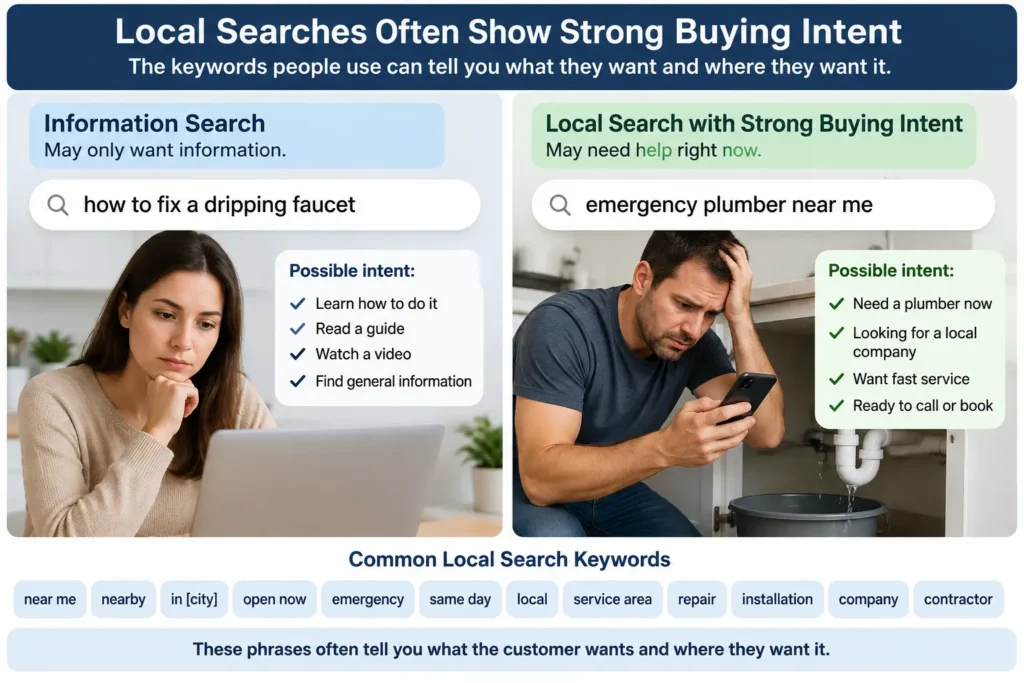
Local Searches Often Show Strong Buying Intent
A person searching for “how to fix a dripping faucet” may only want information.
A person searching for “emergency plumber near me” may need help right now.
That difference matters.
Local searches often contain words such as:
- near me
- nearby
- in [city]
- open now
- emergency
- same day
- local
- service area
- repair
- installation
- company
- contractor
These phrases often tell you what the customer wants and where they want it.
Home Service Businesses Can Benefit
Local SEO works particularly well for businesses that travel to customers.
Common examples include:
- Plumbers
- Electricians
- HVAC contractors
- Roofers
- Pest control companies
- Cleaning companies
- Landscapers
- Painters
- Garage door repair companies
- Locksmiths
- Appliance repair businesses
- Handyman services
- Carpet cleaners
- Window cleaners
- Solar installers
- Water damage restoration companies
Google specifically supports service-area businesses, such as plumbers and cleaning services, that visit customers instead of serving them at a public storefront.
How Local SEO Works
Local SEO is easier to understand if you think of Google as a matchmaker.
A customer says, “I need a plumber near me.”
Google tries to find businesses that are relevant to that search and appropriate for the user’s location.
Your business information helps Google understand:
- What your business does.
- Where you operate.
- Whether your business is relevant to the search.
- What customers say about you.
- What information exists about your business across the web.
Google collects local business information from several sources, including websites, business owners, third parties, and user contributions.
Google Business Profile
Your Google Business Profile is one of the most important parts of local SEO.
It can appear on Google Search and Google Maps and can show information such as your business name, phone number, hours, website, photos, reviews, services, and location.
Think of it as your digital shop window.
If the information is missing or outdated, customers may move on to another business.
Local Search Rankings
Google says local results are mainly influenced by relevance, distance, and prominence.
That means a business needs to be relevant to the search, reasonably close to the customer, and established enough for Google to understand its local presence.
There is no legitimate trick that guarantees the top position for every local search.
Step-by-Step Local SEO Strategy
You do not need to fix everything in one weekend.
Start with the basics, then build from there.
1. Claim and Verify Your Google Business Profile
First, make sure you control your business listing.
Google allows eligible businesses to add or claim a Business Profile at no charge.
After verification, check every field.
Your profile should contain:
- Real business name
- Correct phone number
- Accurate website
- Correct business category
- Business hours
- Holiday hours when needed
- Accurate address, if customers visit you
- Correct service area, if you travel to customers
- Services
- Photos
- Business description
Do not add extra keywords to your business name just to rank.
Google’s guidelines say your business name should match the real-world name used by the business.
Example: Plumber
Bad business name:
Best Emergency Plumber Cheap Plumber Lahore 24/7
Better:
ABC Plumbing Services
Then use your profile’s proper service and description fields to explain what you actually offer.
2. Choose the Right Business Category
Your primary category helps Google understand what your business is.
A plumber should not choose a category just because another business uses it.
Choose the category that best describes your core business.
Google recommends using the fewest categories needed to describe the overall business accurately.
Example
If your company mainly provides plumbing services, make plumbing the core category.
Do not turn every service into a separate business category.
3. Set Your Service Area Correctly
This step matters for home service companies.
Suppose you operate a mobile plumbing business. Customers do not visit your house or office. You travel to them.
You can use a service area instead of displaying a residential address.
Google’s guidelines say service-area businesses should use an accurate service area and hide the address when customers are not served at that address.
Example
A plumber based in Lahore might serve:
- Gulberg
- Johar Town
- Model Town
- DHA
- Garden Town
Only list areas you actually serve.
Do not create fake offices in every neighborhood.
4. Add Your Services
Your customers should quickly understand what you do.
For example, a plumbing company might list:
- Emergency plumbing
- Drain cleaning
- Water heater repair
- Pipe repair
- Leak detection
- Faucet repair
- Toilet repair
- Sewer line repair
Google allows eligible service businesses to add services directly to their Business Profile.
This also helps customers understand your offer before they call.
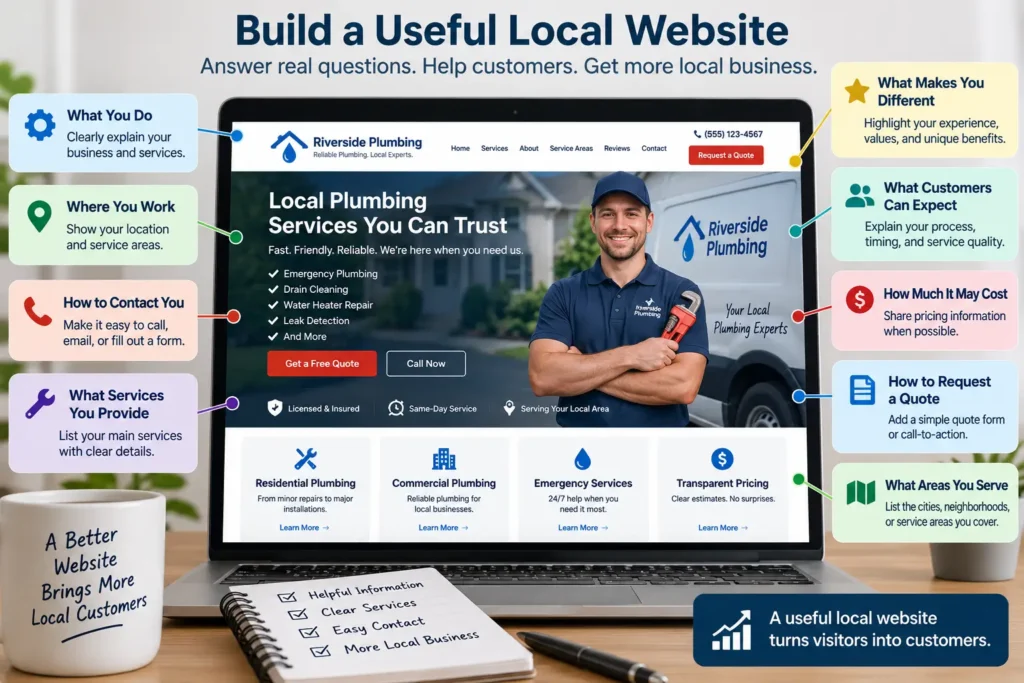
5. Build a Useful Local Website
Your website should not simply say:
We are the best local service company.
It should answer real customer questions.
A good local business website tells people:
- What you do
- Where you work
- How to contact you
- What services you provide
- What makes your business different
- What customers can expect
- How much a service may cost, when appropriate
- How to request a quote
- What areas you serve
6. Create Service Pages
Do not put every service on one giant page.
Create useful pages when each service deserves its own explanation.
For example:
/plumbing//emergency-plumbing//water-heater-repair//drain-cleaning//leak-detection/
A roofing company might create:
- Roof repair
- Roof replacement
- Roof inspection
- Storm damage repair
- Metal roofing
- Flat roof repair
The goal is not to create hundreds of thin pages.
The goal is to create pages that genuinely help customers.
7. Create Location Pages Carefully
Location pages can help when you genuinely serve those areas.
For example:
Plumbing Services in Johar Town
A useful page could explain:
- Services available in the area
- Common local customer problems
- Service hours
- How appointments work
- Nearby areas served
- Real examples of completed work
- How to contact the company
Do not simply replace the city name 50 times on the same page.
That creates a page that sounds unnatural.
8. Keep Your Business Information Consistent
Your business information should match across important websites.
This includes:
Name + Address + Phone number
Often called NAP.
For example:
ABC Plumbing Services
123 Main Road
Lahore
+92 XXX XXXXXXX
Try to keep important business details consistent on:
- Your website
- Google Business Profile
- Local directories
- Industry directories
- Social profiles
- Chamber or association pages
Google uses information from different sources when building local listings.
9. Get Genuine Customer Reviews
Reviews can help customers decide whether to contact you.
Imagine two electricians appear in a search.
One has a detailed profile with recent customer feedback.
The other has almost no reviews.
The first business may give the customer more information to consider.
Ask real customers for honest feedback after completing a job.
Do not buy reviews.
Do not create fake reviews.
Do not pressure customers to leave only positive reviews.
Google displays review scores and review counts on local business profiles.
A Simple Review Process
After finishing a job:
- Thank the customer.
- Ask if they are happy with the service.
- Send your review request.
- Make the process easy.
- Respond professionally to reviews.
A simple message might say:
Thanks for choosing us for your electrical repair. If you have a moment, we’d appreciate your honest feedback on Google.
10. Respond to Reviews
Reviews are not just about stars.
Your replies also show future customers how you communicate.
For a positive review:
Thank you, Sarah. We’re glad we could repair the water heater and get everything working again.
For a negative review:
Thanks for sharing your experience. We’re sorry the service did not meet your expectations. Please contact our office so we can review what happened.
Keep replies calm and professional.
Google also recommends responding to reviews as part of managing a Business Profile.
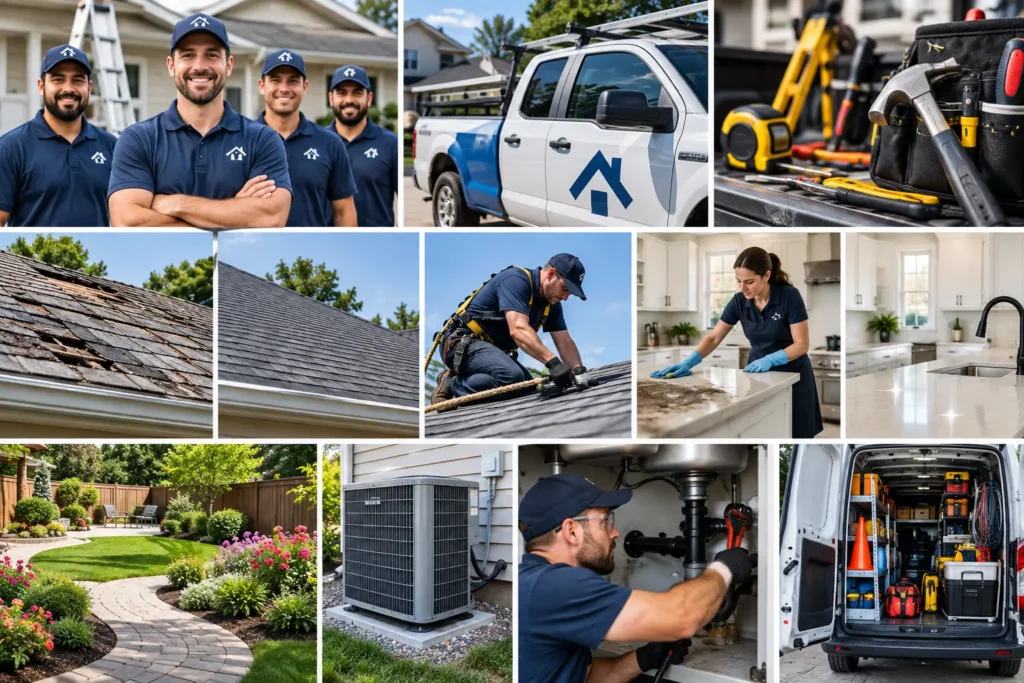
11. Add Real Photos
A local business should look real online.
For a home service company, useful photos include:
- Team members
- Branded vehicles
- Tools
- Completed projects
- Before-and-after work
- Equipment
- Office or storefront
- Job sites
- Products installed
- Safety equipment
A roofing company could show a roof before repair and after completion.
A cleaner could show a real kitchen cleaning project.
A landscaper could show a finished garden.
Google recommends adding photos and videos to help customers understand the business.
12. Build Local Links
A local link is a link from another website to yours.
But not every link is equally useful.
A relevant local link can make more sense than a random website that has nothing to do with your business.
Potential sources include:
- Local business associations
- Chambers of commerce
- Local news sites
- Trade organizations
- Suppliers
- Community organizations
- Local sponsorships
- Industry publications
- Local event websites
For example, a local HVAC company sponsors a community event. The event website lists sponsors and links to the company’s website.
That is a natural local connection.
13. Create Helpful Local Content
Blog posts can support your local SEO strategy when they answer real customer questions.
For a plumber:
- How much does drain cleaning cost?
- Why does my water heater make noise?
- How often should pipes be inspected?
- What causes low water pressure?
- When should you call an emergency plumber?
For a roofer:
- How to spot roof damage
- When should a roof be replaced?
- What to do after storm damage
- Roof repair versus roof replacement
For an electrician:
- Why does a circuit breaker keep tripping?
- When should you replace an electrical panel?
- Signs your home needs an electrical inspection
This content can attract people before they are ready to buy.
Local SEO Keywords for Small Businesses
Keywords are simply the words people use when searching.
The trick is to think like your customer.
Local Keyword Examples
A plumber might target:
- plumber near me
- plumber in Lahore
- emergency plumber Lahore
- drain cleaning Lahore
- water heater repair Lahore
- leak detection Lahore
An electrician might target:
- electrician near me
- electrician in Lahore
- emergency electrician Lahore
- electrical repair Lahore
- home electrician Lahore
- electrical panel repair
A cleaning company might target:
- house cleaning near me
- home cleaning Lahore
- deep cleaning Lahore
- move out cleaning Lahore
- office cleaning Lahore
Use Natural Language
Do not write:
Looking for the best plumber in Lahore? Our plumber Lahore service is the best plumber Lahore customers can find for plumber services in Lahore.
Nobody talks like that.
Instead:
Need a plumber in Lahore? Our team handles leaks, blocked drains, water heater repairs, and emergency plumbing calls.
It is clearer for people and easier to understand.
Local SEO for Service-Area Businesses
Service-area businesses have a slightly different setup.
You may not have a storefront.
Your customers may never visit your office.
Instead, you go to them.
Examples of Service-Area Businesses
Common examples include:
- Plumbers
- Electricians
- Roofers
- HVAC contractors
- Mobile mechanics
- Cleaning companies
- Pest control services
- Landscapers
- Handymen
- Appliance repair technicians
Google allows eligible service-area businesses to create a Business Profile and define the areas they serve.
Do Not Create Fake Locations
This is one of the biggest local SEO mistakes.
Suppose your electrician business operates from one real location.
You should not create fake offices in 15 cities just to rank there.
Instead, build useful service-area content around the places you genuinely serve.
Your business should be represented accurately online. Google’s guidelines specifically warn against inaccurate addresses and unnecessary additional profiles.
Local Citations and Directory Listings
A citation is a mention of your business on another website.
It may include:
- Business name
- Address
- Phone
- Website
- Category
Examples include local directories, trade directories, and business association websites.
Are Citations Still Useful?
Yes, accurate business information across trusted sources can help reinforce what your business is and where it operates.
But do not spend all your time submitting your business to hundreds of low-quality directories.
Focus on relevant and trustworthy places.
Local SEO and Mobile Search
Many local searches happen when people are already out and about.
Someone may search from a phone while:
- Standing in a parking lot
- Sitting at home with a broken appliance
- Driving home after work
- Looking for an open business
- Comparing service providers
That means your website should work well on mobile devices.
Make it easy to:
- Call
- Get directions
- Request a quote
- Book an appointment
- See business hours
- Understand your services
For a home service business, a clear Call Now button can be more useful than a complicated homepage.
Local Business Schema Markup
Structured data gives search engines additional information about your business.
Google recommends using the most specific LocalBusiness subtype that applies to your business and providing relevant business details.
For example, your website may identify information such as:
- Business name
- Address
- Phone number
- Website
- Opening hours
- Service information
- Geographic details
Schema does not guarantee higher rankings.
Its main purpose is to help search engines understand the information on a page.
Example LocalBusiness Schema
Use real information before publishing this markup. Do not copy the sample address, phone number, or URLs.
{
  "@context": "https://schema.org",
  "@type": "LocalBusiness",
  "name": "Example Home Services",
  "url": "https://www.example.com/",
  "telephone": "+92-XXX-XXXXXXX",
  "address": {
    "@type": "PostalAddress",
    "streetAddress": "123 Example Road",
    "addressLocality": "Lahore",
    "addressCountry": "PK"
  },
  "areaServed": [
    {
      "@type": "City",
      "name": "Lahore"
    }
  ]
}
Google provides official documentation for LocalBusiness structured data and recommends using the most specific business subtype that fits the organization.
Common Local SEO Mistakes
Small businesses often make the same mistakes.
Fixing these can be more useful than chasing complicated SEO tactics.
Keyword Stuffing
Using the same keyword again and again makes content difficult to read.
Write for customers first.
Fake Reviews
Fake reviews can damage trust and violate platform policies.
Build reviews through real customer experiences.
Fake Business Locations
Do not create fake offices in areas where you do not operate.
Use real service areas.
Wrong Business Category
Choose a category that accurately represents the main business.
Do not treat categories as a list of keywords.
Outdated Business Hours
Imagine a customer finds your business on Google, drives over, and discovers you are closed.
That is a poor customer experience.
Update regular and special hours.
Thin Location Pages
Changing “Lahore” to “Islamabad” on 30 nearly identical pages does not create useful local content.
Give each page a real reason to exist.
Ignoring Reviews
A business that never responds to customers misses a simple opportunity to show professionalism.
Forgetting the Website
A Google Business Profile is important, but your website still matters.
Your website can explain services, answer questions, show examples of your work, and convert visitors into leads.
Local SEO Checklist for Small Businesses
Use this checklist to find quick improvements.
Google Business Profile Checklist
- Profile claimed
- Profile verified
- Correct business name
- Correct primary category
- Accurate phone number
- Accurate website
- Correct hours
- Correct address or service area
- Services added
- Business description completed
- Real photos added
- Reviews monitored
- Reviews answered
Website Checklist
- Clear homepage
- Service pages
- Location information
- Contact page
- Click-to-call phone number
- Mobile-friendly design
- Fast loading pages
- Clear calls to action
- Helpful local content
- Consistent business information
- Appropriate LocalBusiness schema
Reputation Checklist
- Ask real customers for reviews
- Never buy reviews
- Respond to positive reviews
- Respond professionally to negative reviews
- Add new project photos
- Keep customer information private
How to Measure Local SEO Results
Do not judge local SEO only by rankings.
A better question is:
Is local search bringing me real customers?
Google Business Profile performance can show how people discover and interact with your profile, including searches, views, and customer actions.
Track These Metrics
| Metric | Why It Matters |
|---|---|
| Google Business Profile views | Shows profile visibility |
| Search queries | Shows how people discover you |
| Website clicks | Measures interest |
| Phone calls | Important for service businesses |
| Direction requests | Useful for physical locations |
| Quote requests | Measures leads |
| Bookings | Measures conversions |
| Review count | Shows customer feedback volume |
| Review quality | Helps customers evaluate your business |
For a plumber, 20 qualified phone calls may matter more than a jump from position 8 to position 5 for one keyword.
How Long Does Local SEO Take?
There is no fixed timeline.
A new business may need time to establish accurate information, collect customer feedback, build website content, and develop local authority.
Google notes that new businesses can take time to appear in search results, and changes to business information may also take time to appear.
Think of local SEO like planting a garden.
You can prepare the soil quickly.
But the results grow over time.
The best approach is steady work rather than making dozens of changes one day and doing nothing for six months.
A Simple 90-Day Local SEO Plan
You do not need a huge marketing team.
A small business owner can start with a simple schedule.
Days 1–30: Fix the Foundation
Focus on accuracy.
- Claim your Google Business Profile.
- Verify it.
- Correct your business information.
- Choose the right category.
- Set the correct service area.
- Add services.
- Add real photos.
- Fix website contact information.
- Make sure the website works well on mobile.
Days 31–60: Build Trust
Now focus on customers and content.
- Ask recent customers for honest reviews.
- Respond to existing reviews.
- Create important service pages.
- Create useful location pages where appropriate.
- Publish helpful customer questions.
- Improve calls to action.
- Look for relevant local partnerships.
Days 61–90: Improve and Measure
Now look at the data.
- Check Business Profile performance.
- Review search queries.
- Check which pages receive traffic.
- Track calls and leads.
- Find pages with poor engagement.
- Improve weak service pages.
- Add useful photos from recent jobs.
- Look for missing local topics.
Expert Tips for Home Service Businesses
Small improvements can make a big difference when they match how customers actually search.
Show the Work
A roofer can show a damaged roof and the completed repair.
An electrician can show a completed panel installation.
A cleaner can show a real deep-cleaning project.
Real evidence is easier for customers to trust than generic stock photos.
Explain What Happens After the Call
People often hesitate because they do not know what happens next.
Tell them.
For example:
Call us and describe the problem. We will ask a few questions, confirm whether we serve your area, and arrange a service time.
Simple information removes uncertainty.
Answer Price Questions Carefully
Customers want to know about cost.
Instead of promising an exact price for every job, explain what affects the price.
For example:
Drain cleaning costs can vary depending on the blockage, access, equipment needed, and condition of the pipe.
This is more useful than saying:
Call for pricing.
Make Emergency Services Obvious
If you offer emergency plumbing, electrical, HVAC, or restoration services, make that clear.
A person with a burst pipe should not have to hunt through your website to find your emergency number.
Pros and Cons of Local SEO
Pros
- Helps people in your service area find you.
- Can attract customers with strong local intent.
- Builds long-term online visibility.
- Supports Google Maps and Search visibility.
- Helps customers learn about your services.
- Can work well for home service businesses.
- Builds trust through reviews and real project information.
Cons
- Results can take time.
- Requires regular maintenance.
- Reviews need ongoing attention.
- Local competition can be strong.
- Business information must stay accurate.
- There is no guaranteed ranking position.
Frequently Asked Questions
What is local SEO for small businesses?
Local SEO helps a small business appear when nearby customers search for its products or services. It includes Google Business Profile optimization, website content, reviews, local citations, and location signals.
Is local SEO worth it for a small business?
Local SEO can be useful when your customers are concentrated in a specific area. It is especially relevant for plumbers, electricians, roofers, cleaners, restaurants, clinics, contractors, and other local businesses.
Can a home service business use Google Business Profile?
Yes. Eligible service-area businesses can use a Google Business Profile even when customers do not visit their business address. They can specify the areas they serve.
Should a small business create a page for every city?
No. Create location pages when you genuinely serve those areas and can provide useful, unique information. Avoid making dozens of nearly identical pages that only change the city name.
Why do Google reviews matter for local businesses?
Reviews give potential customers information about other people’s experiences. Google displays review scores and review counts for local businesses, making reviews part of how customers evaluate businesses.
When should a small business start local SEO?
Start with the basics as soon as your business is ready to serve customers. Claim your profile, make your information accurate, build your website, collect genuine reviews, and improve your local presence over time.
Final Verdict: Local SEO Helps Small Businesses Get Found
Local SEO for small businesses is not about stuffing a city name into every sentence.
It is about making your business easy to understand and easy to find.
Tell Google what you do.
Tell customers where you work.
Show real examples of your work.
Keep your business information accurate.
Ask real customers for honest reviews.
Build useful service and location content.
Then measure what brings calls, leads, bookings, and customers.
For a local plumber, roofer, electrician, cleaner, landscaper, or HVAC company, that simple approach can create a much stronger online presence than chasing complicated SEO tricks.
External Sources
- Google Business Profile local ranking guidance
- Google guidelines for representing a business
- Google LocalBusiness structured data documentation
- Google Business Profile performance guidance