


When you search for “plumber,” you get a huge range of results. Search for “emergency plumber in Phoenix for a burst pipe,” and the search becomes much more specific.
That simple difference explains long-tail vs short-tail keywords. One targets a broad topic. The other targets a specific need.
For a home-service business, knowing the difference can help you attract the right visitors, build useful pages, and turn more searches into calls and leads.
What Are Long-Tail and Short-Tail Keywords?
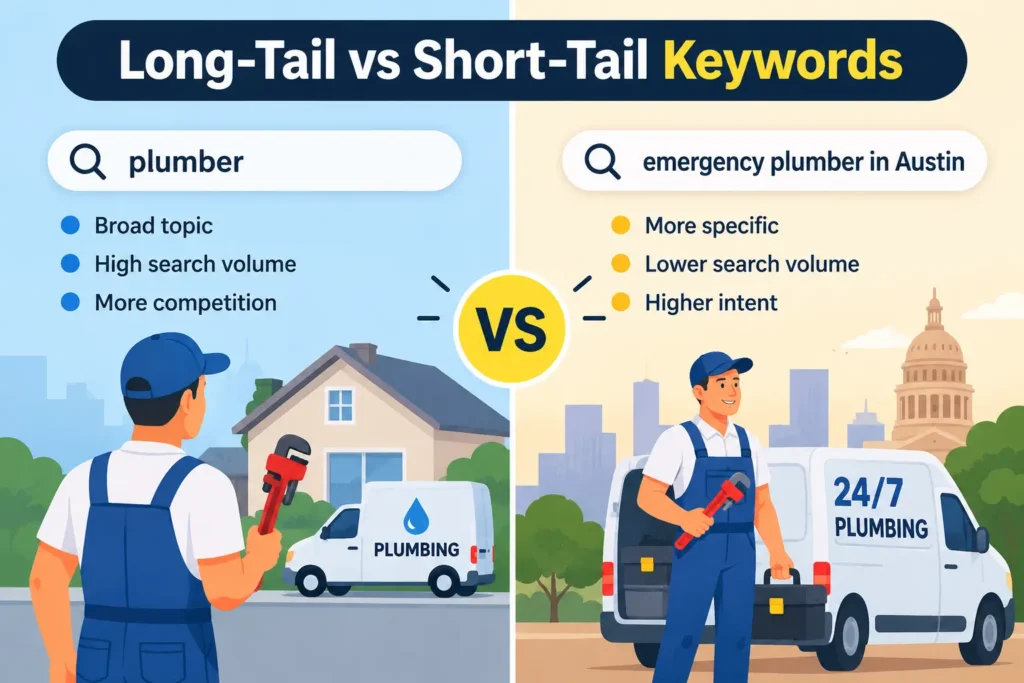
Short-tail keywords are broad search terms with a wide meaning. Long-tail keywords are more specific searches that usually show a clearer search intent.
The names can be slightly misleading. A long-tail keyword does not have to be long, and a short-tail keyword does not always contain only one or two words. The main difference is search demand, specificity, and intent.
Quick Reference Table
| Factor | Short-Tail Keywords | Long-Tail Keywords |
|---|---|---|
| Example | plumber | emergency plumber in Phoenix |
| Meaning | Broad | Specific |
| Search intent | Often unclear | Usually clearer |
| Competition | Often high | Often lower, but not always |
| Search volume | Usually higher | Usually lower |
| Conversion potential | Depends on intent | Often strong for service searches |
| Best use | Topic and seed research | Targeted pages and service content |
| Local example | AC repair | AC repair in Dubai Marina |
| Question example | roofing | how much does roof repair cost in Dallas |
Long-Tail vs Short-Tail Keywords: The Main Difference
The biggest difference is not simply the number of words. It is how specific the search is and how many people search for it.
Think about a person standing outside a hardware store.
They say, “I need tools.”
That is broad.
Then they say, “I need a 12-inch pipe wrench for a leaking kitchen pipe.”
Now you know exactly what they need.
Search keywords work in a similar way.
What Is a Short-Tail Keyword?
A short-tail keyword is a broad search term that can cover many different needs.
Examples include:
- plumber
- roofing
- electrician
- HVAC
- pest control
- landscaping
- home cleaning
- water heater
- air conditioning
- bathroom remodeling
Someone searching for “plumber” could want a plumber for almost anything.
They might need:
- leak repair
- drain cleaning
- water heater repair
- pipe replacement
- emergency plumbing
- bathroom plumbing
- commercial plumbing
That makes the search term broad.
Short-tail keywords are useful because they help you understand the main topic of a website or service category. They can also act as seed keywords when you begin keyword research.
What Is a Long-Tail Keyword?
A long-tail keyword is a more specific search query that usually has lower search demand than a broad head term.
Examples include:
- emergency plumber in Austin
- plumber for burst pipe in Houston
- AC repair near Downtown Dubai
- water heater repair in Abu Dhabi
- affordable house cleaning in Miami
- roof leak repair in Phoenix
- termite treatment for residential homes in Dubai
The searcher has already told you more about what they need.
That makes the query easier to match with a specific service page.
Ahrefs notes that long-tail keywords are generally more specific and often have lower search demand than head terms. It also points out that word count alone does not define a long-tail keyword.
How Short-Tail Keywords Work
Short-tail keywords sit at the broad end of the search-demand curve.
They can bring many types of searches together under one topic.
Example: “Plumber”
Imagine a plumbing company in Dallas.
Its short-tail keyword might be:
plumber
But the people searching that term could be looking for:
- a residential plumber
- a commercial plumber
- an emergency plumber
- a drain cleaning company
- a local plumber
- plumbing prices
- plumbing advice
- plumbing jobs
The company cannot know the exact need from that keyword alone.
That is the main challenge with broad keywords.
When Short-Tail Keywords Are Useful
Short-tail keywords can help when you are:
- Building a website structure.
- Finding seed keywords.
- Creating service categories.
- Planning content clusters.
- Understanding a broad market.
- Building brand awareness.
- Researching competitors.
They are often the starting point rather than the entire strategy.
How Long-Tail Keywords Work
Long-tail keywords narrow the search.
They add details such as location, service type, problem, price, urgency, property type, or customer need.
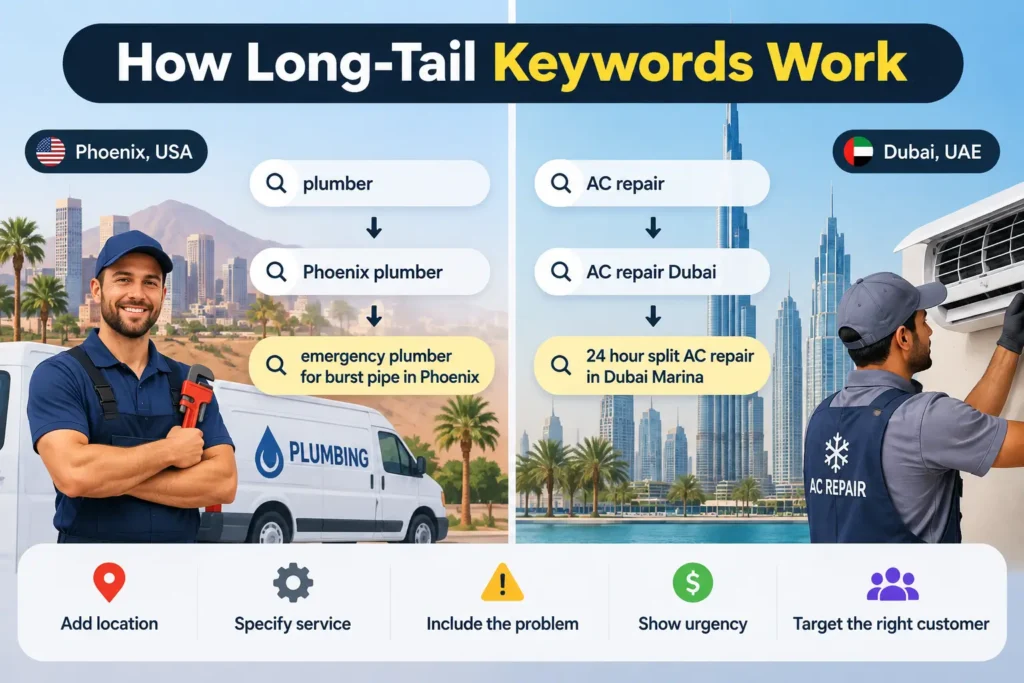
Example: A USA Plumber
A plumbing company in Phoenix could target:
Short-tail:
plumber
More specific:
Phoenix plumber
Long-tail:
emergency plumber for burst pipe in Phoenix
The final search tells you much more.
The person probably has a plumbing problem right now.
That can create strong commercial intent.
Example: A UAE AC Company
Consider an AC company serving Dubai.
A broad keyword might be:
AC repair
A local keyword might be:
AC repair Dubai
A more specific keyword could be:
split AC repair in Dubai Marina
An even more specific search might be:
24 hour split AC repair in Dubai Marina
Each added detail reduces ambiguity.
The business can then create a page or section that directly addresses that need.
USA Home Service Keyword Examples
Home services are a good way to understand the difference because customers often search with a problem in mind.
They do not always start with the name of a company or service.
Plumbing Keywords
| Short-Tail | Long-Tail |
|---|---|
| plumber | emergency plumber in Dallas |
| plumbing | plumbing company near Austin |
| drain cleaning | sewer drain cleaning in Phoenix |
| water heater | tankless water heater repair in Houston |
| leak repair | ceiling water leak plumber in Miami |
HVAC Keywords
| Short-Tail | Long-Tail |
|---|---|
| HVAC | HVAC repair in Dallas |
| AC repair | emergency AC repair in Phoenix |
| air conditioning | central AC repair near Orlando |
| furnace repair | furnace repair company in Denver |
| heating | residential heating repair in Chicago |
Roofing Keywords
| Short-Tail | Long-Tail |
|---|---|
| roofing | residential roofing company in Dallas |
| roofer | emergency roofer in Houston |
| roof repair | roof leak repair in Phoenix |
| roof replacement | asphalt shingle roof replacement in Austin |
| roofing company | local roofing contractor in Miami |
Notice the pattern.
The long-tail keyword often adds location + service + problem or property type.
That combination can make the search much more useful for a local business.
UAE Home Service Keyword Examples
The same principle works in the UAE.
A Dubai customer may search differently from someone in New York, but the underlying intent is similar.
They have a problem and want a solution.
AC Repair Keywords
| Short-Tail | Long-Tail |
|---|---|
| AC repair | AC repair in Dubai |
| AC service | AC service in Jumeirah |
| air conditioning | split AC repair in Dubai Marina |
| AC maintenance | residential AC maintenance in Abu Dhabi |
Plumbing Keywords
| Short-Tail | Long-Tail |
|---|---|
| plumber | plumber in Dubai |
| plumbing | emergency plumber in JVC Dubai |
| leak repair | water leak repair in Dubai Marina |
| drain cleaning | kitchen drain cleaning in Abu Dhabi |
Cleaning Service Keywords
| Short-Tail | Long-Tail |
|---|---|
| cleaning services | home cleaning services in Dubai |
| house cleaning | weekly house cleaning in Jumeirah |
| deep cleaning | deep cleaning service for villas in Dubai |
| sofa cleaning | sofa cleaning service in Abu Dhabi |
Pest Control Keywords
| Short-Tail | Long-Tail |
|---|---|
| pest control | pest control in Dubai |
| termite control | termite treatment for villas in Dubai |
| bed bug control | bed bug treatment in Abu Dhabi apartments |
| cockroach control | cockroach pest control in JLT |
For UAE businesses, location terms can be especially useful.
Examples include:
- Dubai
- Abu Dhabi
- Sharjah
- Ajman
- Jumeirah
- Dubai Marina
- JVC
- Business Bay
- Downtown Dubai
- Al Barsha
Use location terms naturally. Do not create dozens of nearly identical pages just by changing the neighborhood name.
Why Search Intent Matters More Than Keyword Length
A keyword can be long and still be difficult to rank for.
A keyword can also be short and have valuable commercial intent.
That is why keyword length should never be the only deciding factor.
Four Common Search Intent Types
Search intent is the reason behind a search.
It usually falls into four broad groups.
Informational Intent
The person wants information.
Examples:
- how to fix a leaking faucet
- how often should AC filters be changed
- what causes low water pressure
These searches can support blog posts and helpful guides.
Navigational Intent
The person wants a specific website or business.
Examples:
- Home Depot
- ABC Plumbing
- Carrier HVAC service Dubai
The searcher already has a destination in mind.
Commercial Investigation
The person is comparing options.
Examples:
- best HVAC companies in Dallas
- AC repair cost in Dubai
- roofing companies near Houston
- best pest control company in Abu Dhabi
These searches often happen before a purchase.
Transactional Intent
The person is ready to take action.
Examples:
- emergency plumber near me
- book AC repair Dubai
- roof repair quote Dallas
- pest control service near me
These searches can be highly valuable for local service businesses.
Long-Tail vs Short-Tail Keywords for Local SEO
Local SEO makes the difference even clearer.
A broad term like “plumber” does not tell Google or the business where the customer needs service.
A phrase like “emergency plumber in Tampa” gives much more context.
Add Location Carefully
Local long-tail keywords can include:
- city
- neighborhood
- ZIP code
- service area
- “near me”
- property type
- specific service
- specific problem
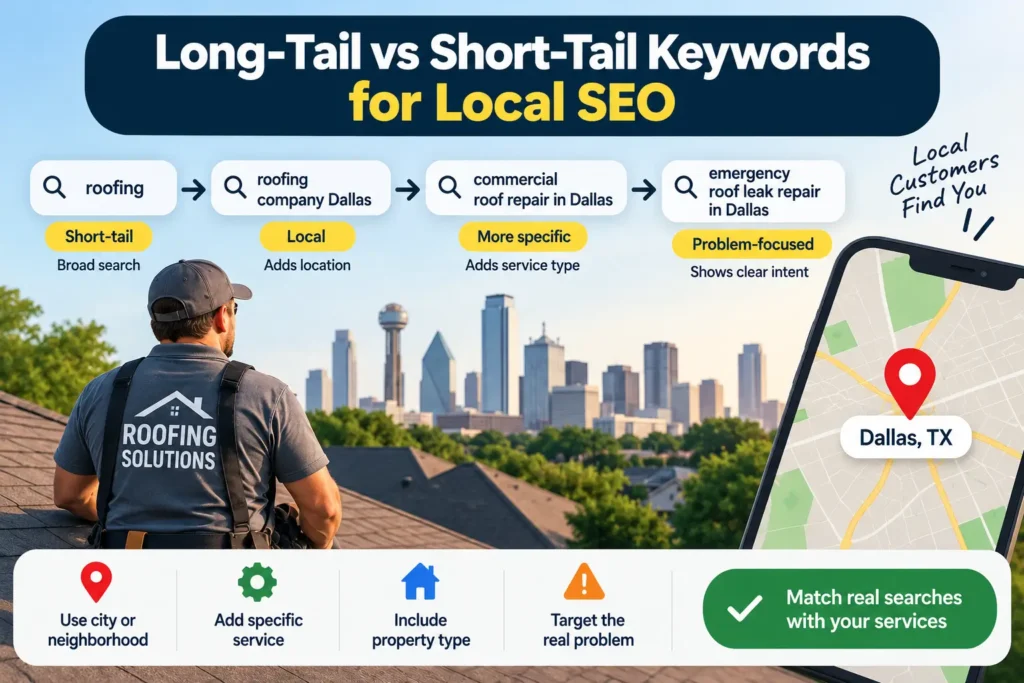
For example:
Short-tail:
roofing
Local:
roofing company Dallas
More specific:
commercial roof repair in Dallas
Problem-focused:
emergency commercial roof leak repair in Dallas
Each version carries more context.
But do not assume that longer automatically means better.
A useful keyword must match what people actually search and what your business actually offers.
Long-Tail Keywords and Conversion Rates
Long-tail keywords are often associated with higher conversion potential because they can show clearer intent.
But this is not a guarantee.
A search such as “plumber” might come from someone who needs a plumber immediately.
A long search such as “how to replace a faucet cartridge” might come from someone who wants to do the job themselves.
So intent matters more than word count.
A Simple Example
Imagine two searches:
“AC repair”
and
“24 hour AC repair in Dubai Marina”
The second search gives a business more information.
The person has indicated:
- the service
- urgency
- location
- type of need
That does not guarantee a sale.
But it gives the business a clearer opportunity to answer the need.
Should You Target Long-Tail or Short-Tail Keywords?
Most businesses do not need to choose only one.
A balanced keyword strategy can use both.
Use Short-Tail Keywords for Topic Structure
Start with broad terms.
For a plumbing company, you might have:
- plumbing
- plumber
- drain cleaning
- water heater
- leak repair
These become your seed keywords.
Then expand each topic into more specific searches.
Build Long-Tail Keywords Around Customer Problems
For “water heater,” you could research:
- water heater repair
- water heater repair near me
- water heater repair in Dallas
- tankless water heater repair Dallas
- water heater leaking from bottom
- emergency water heater repair
Now you have a much clearer picture of what customers need.
How to Find Long-Tail Keywords
You do not need complicated software to start.
Begin with the questions customers ask every day.
Step 1: Start With a Seed Keyword
Pick a broad service.
Example:
AC repair
Step 2: Add a Location
Try:
AC repair Dubai
Then narrow it:
AC repair in Dubai Marina
Step 3: Add a Problem
Try:
- AC not cooling
- AC leaking water
- AC making noise
- AC not turning on
You can combine these with location terms where natural.
For example:
AC not cooling repair in Dubai
Step 4: Add Customer Questions
People often search using questions.
Examples:
- how much does AC repair cost in Dubai
- why is my AC leaking water
- how often should home AC be serviced
- how much does a plumber cost in Phoenix
Question-based keywords can become useful FAQ sections and informational content.
Step 5: Check Search Results
Search the keyword yourself.
Look at:
- local businesses
- service pages
- blog posts
- People Also Ask questions
- maps results
- related searches
The results can show you what Google believes the query means.
Keyword Research Tools to Consider
Keyword research tools can help you estimate search volume, competition, related terms, and search trends.
Common options include:
- Google Keyword Planner
- Google Search Console
- Google Trends
- Ahrefs
- Semrush
- Moz Keyword Explorer
- Ubersuggest
Google Ads also uses keyword match types such as broad, phrase, and exact match for advertising. These match types are different from the SEO classification of short-tail and long-tail keywords, so do not mix the two concepts.
Common Mistakes to Avoid
Keyword research can go wrong when businesses focus too much on numbers.
A keyword with huge search volume is not automatically the best keyword for your business.
Mistake 1: Chasing Only High-Volume Keywords
“Plumber” may look attractive because it is broad.
But a small local plumbing company may have a better opportunity with searches such as:
emergency plumber in Phoenix
The exact opportunity depends on the market, competition, location, authority, and search intent.
Mistake 2: Assuming Every Long Keyword Is Easy
Long-tail does not mean “easy.”
Some specific keywords can still be highly competitive.
Always check the actual search results.
Mistake 3: Stuffing Keywords Into a Page
Do not write:
“Our Dallas plumber is the best Dallas plumber for Dallas plumbing because our Dallas plumbing company provides Dallas plumbing.”
That sounds unnatural.
Write for people first.
Google’s guidance and modern search systems focus heavily on relevance and meaning rather than simply repeating the same phrase.
Mistake 4: Creating One Page for Every Tiny Variation
You usually do not need separate pages for:
- plumber Dallas
- plumbers Dallas
- Dallas plumbing
- plumbing Dallas TX
- Dallas plumber services
If the search intent is essentially the same, one strong page may serve the topic better.
Mistake 5: Ignoring the Actual Service Area
A company should not create pages for cities it does not serve just because those keywords have search volume.
That can create poor user experiences and weak local relevance.
Long-Tail Keyword Checklist
Before targeting a long-tail keyword, ask these questions.
- Does my business provide this service?
- Does the keyword match my location?
- Does the search show clear intent?
- Can I create a genuinely useful page?
- Does the keyword solve a real customer problem?
- Are similar keywords already covered by an existing page?
- Does the search result page contain local businesses?
- Can I answer the question better than a basic definition?
- Is the keyword natural enough to use in a sentence?
If most answers are yes, the keyword may deserve a place in your content plan.
How to Build a Home-Service Keyword Cluster
Think of your keyword strategy like a house.
The short-tail keyword is the front door.
The long-tail keywords are the rooms.
For example:
Main topic: Plumbing
Service pages:
- Drain cleaning
- Water heater repair
- Leak detection
- Sewer line repair
- Emergency plumbing
Location pages where genuinely useful:
- Plumbing services in Dallas
- Plumbing services in Fort Worth
Supporting questions:
- How much does a plumber cost?
- What causes low water pressure?
- Why is my water heater leaking?
- How do I know if I have a slab leak?
This creates a logical content structure.
The pages support each other without forcing the same keyword everywhere.
Long-Tail vs Short-Tail Keywords: Pros and Cons
Neither keyword type is automatically better.
Each serves a different purpose.
Short-Tail Keyword Pros
- Large potential search audience
- Useful for topic research
- Good seed keywords
- Helpful for category pages
- Can support broad brand visibility
Short-Tail Keyword Cons
- Broad search intent
- Often competitive
- Can be difficult for newer websites
- May bring visitors who are not ready to buy
- Harder to create one page that satisfies every possible intent
Long-Tail Keyword Pros
- More specific
- Often clearer search intent
- Useful for local SEO
- Good for service-specific content
- Can target customer problems directly
- Helpful for question-based searches
Long-Tail Keyword Cons
- Usually lower individual search volume
- Some phrases may have very little demand
- Can become repetitive if over-segmented
- Not every long-tail keyword is low competition
A Practical Strategy for a New Home-Service Website
If you are launching a new website, start with the services that make money.
Do not build 100 blog posts before explaining what your company actually does.
A Simple Content Plan
Start with:
- Homepage
- Main service pages
- Important service-specific pages
- Location pages for real service areas
- Helpful problem-solving articles
- FAQs
- Reviews and trust information
- Contact and quote pages
For example, a new Dubai AC company could start with:
- AC repair Dubai
- AC installation Dubai
- AC maintenance Dubai
- split AC repair Dubai
- AC not cooling troubleshooting
- AC repair cost questions
A Phoenix plumber could build around:
- plumber Phoenix
- emergency plumber Phoenix
- drain cleaning Phoenix
- water heater repair Phoenix
- leak detection Phoenix
- burst pipe emergency repair Phoenix
The exact keywords should be validated with current search data before publishing.
How to Match Keywords to Pages
One common SEO problem is putting too many unrelated keywords on one page.
Instead, match the keyword to the page’s purpose.
| Search | Suitable Page |
|---|---|
| plumber | Plumbing service category |
| emergency plumber Phoenix | Emergency plumbing page |
| water heater repair Phoenix | Water heater service page |
| how to stop a leaking faucet | Informational article |
| plumber cost Phoenix | Pricing or informational page |
| plumbing company Phoenix | Local service page |
This makes the website easier to understand.
It also gives visitors a clearer path.
What About “Near Me” Keywords?
“Near me” searches are common for local services.
Examples include:
- plumber near me
- AC repair near me
- electrician near me
- pest control near me
- house cleaning near me
You do not need to create a page called “plumber near me.”
Instead, build a strong local service page and make your business information clear.
Include:
- service area
- business name
- address when appropriate
- phone number
- opening hours
- services
- local proof
- customer reviews
- clear contact options
Google can use location and other signals to understand local relevance.
Do AI Search and Conversational Search Change Keyword Strategy?
They change how people may phrase searches, but the basic principle remains the same.
People still have needs.
They may simply express those needs in more natural language.
Instead of:
AC repair Dubai
someone might ask:
Who can fix my AC today in Dubai Marina?
Or:
My split AC is leaking water. Who should I call in Dubai?
These searches reveal intent very clearly.
That means your content should answer real customer questions in natural language.
Do not create awkward pages just to repeat exact-match phrases.
Cover the topic fully.
Use related terms naturally, such as:
- AC service
- air conditioning repair
- HVAC technician
- emergency AC repair
- split AC
- AC maintenance
- cooling problems
- local HVAC company
Expert Tips for Home-Service SEO
A few simple habits can make keyword research much more useful.
Think Like the Customer
Ask:
“What would I type into Google if I had this problem?”
A homeowner with a leaking roof may not search for “residential roofing contractor.”
They may search:
roof leaking during rain what should I do
Then, after learning about the problem, they may search:
emergency roof repair near me
The search journey can change as the customer moves from research to action.
Use Customer Language
Your customers may say:
- AC guy
- plumber
- handyman
- cleaner
- roofer
- pest control company
Your website can use professional service terms too, but it should still sound natural.
Track Real Search Queries
If you have Google Search Console data, look at the queries that already bring impressions and clicks.
These can reveal unexpected long-tail searches.
A page targeting “water heater repair” might also receive impressions for:
- water heater leaking
- hot water heater repair
- water heater not heating
- emergency water heater service
Those queries can help you improve the page.
Frequently Asked Questions
What are long-tail keywords?
Long-tail keywords are specific search queries with relatively lower search demand than broader head terms. They often reveal a clearer need, such as “emergency plumber in Phoenix.”
Is a long-tail keyword always better than a short-tail keyword?
No. The right choice depends on the search intent, competition, business goals, and audience. Short-tail keywords are useful for broad topics, while long-tail keywords help target specific needs.
Can short-tail keywords bring customers?
Yes. A broad search such as “plumber” can come from someone who needs a service immediately. The challenge is that the search does not reveal the person’s exact need.
Should a local business focus on long-tail keywords?
Local businesses can benefit from specific service and location searches, such as “water heater repair in Dallas.” However, they should also build strong pages around their main services.
Why are long-tail keywords useful for home services?
They can describe a specific service, problem, location, or urgent need. This makes it easier to create a page that directly answers what the customer is looking for.
Does keyword length determine whether a keyword is long-tail?
No. Keyword length is only a rough clue. Long-tail keywords are mainly defined by their lower search demand and more specific nature compared with broader head terms.
Key Takeaways
- Short-tail keywords cover broad topics.
- Long-tail keywords focus on specific needs.
- Search volume alone does not tell you whether a keyword is valuable.
- Long-tail keywords often make search intent easier to understand.
- Short-tail keywords are useful as seed keywords for research.
- Home-service companies can use both types together.
- Local modifiers such as “near me,” city names, neighborhoods, and service areas can make keywords more specific.
- A good keyword strategy focuses on the customer, not just the keyword.
Final Verdict: Use Both Keyword Types
The strongest keyword strategy does not treat long-tail and short-tail keywords as rivals.
Use short-tail keywords to understand your market and organize your website.
Use long-tail keywords to answer specific customer needs.
For a plumber in the USA or an AC company in the UAE, that could mean building around broad services such as plumbing, roofing, or AC repair, then supporting them with specific searches such as emergency plumber in Phoenix, roof leak repair in Dallas, or split AC repair in Dubai Marina.
The goal is simple.
Help the right person find the right service at the right moment.
References:
Google Ads keyword matching documentation
Ahrefs: What are short-tail keywords?
Ahrefs: What is a long-tail keyword?