


When someone searches “how to fix a leaking faucet” or “how much does AC repair cost?”, they usually want an answer, not a sales pitch. Those searches are built around informational keywords.
For home service businesses in the USA and UAE, informational keywords can help turn simple questions into useful content that builds trust before a customer ever calls.
What Are Informational Keywords?
Informational keywords are search phrases people use when they want to learn, understand, compare, solve a problem, or find an answer.
They are different from searches such as “plumber near me” or “AC repair Dubai”, where the person may already be looking for a service provider.
Common informational keywords include:
- What is HVAC?
- How does central air conditioning work?
- How to unclog a kitchen sink
- Why is my AC not cooling?
- How often should I service my AC?
- How much does water heater repair cost?
- What causes low water pressure?
- How long does a roof repair take?
- Is mold dangerous?
- Can I fix a leaking pipe myself?
The main goal is simple: the searcher wants information.
Why Do Informational Keywords Matter for Home Services?
A homeowner rarely wakes up thinking, “I need a plumbing service page.”
They usually start with a problem.
Maybe the kitchen sink is draining slowly. Maybe the AC is blowing warm air. Maybe a strange smell is coming from the bathroom.
That problem becomes a Google search.
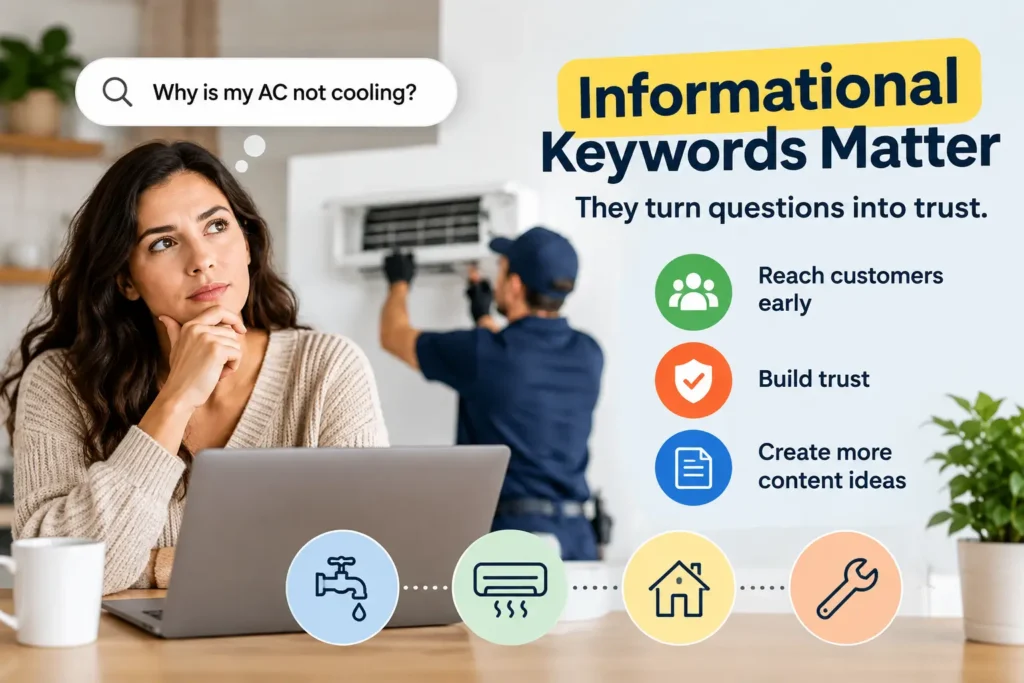
They Reach Customers Before the Phone Call
Informational searches often happen before a customer decides which company to hire.
For example:
USA
“Why is my water heater leaking?”
UAE
“Why is my split AC not cooling in Dubai?”
The first searcher may eventually need a plumber.
The second may eventually need an AC technician.
The informational article gives the business a chance to answer the question early.
They Help Build Trust
Imagine two companies.
Company A says:
“Call us today for the best plumbing service.”
Company B explains:
“A leaking water heater can come from a loose connection, damaged valve, corrosion, or a failed tank. Turn off the water supply first. If the tank itself is leaking, professional replacement may be needed.”
The second company has already helped.
That small moment of usefulness can make the business feel more trustworthy.
They Create More Content Opportunities
A single service can produce dozens of informational topics.
For example, an HVAC company could target:
- Why is my AC not cooling?
- How often should AC filters be changed?
- How long does an AC unit last?
- What causes AC water leaks?
- Why is my AC making a loud noise?
- How much does AC maintenance cost?
- What size AC do I need?
- Is duct cleaning necessary?
- How can I lower my AC bill?
These topics create a connected content cluster around air conditioning, HVAC maintenance, cooling systems, and home comfort.
Informational vs Commercial vs Transactional Keywords
Not every search has the same intent.
Understanding the difference helps you create the right page for the right person.
| Search intent | Example keyword | What the user wants |
|---|---|---|
| Informational | how to fix a dripping faucet | An answer or solution |
| Commercial | best plumber for water heater repair | Options before hiring |
| Transactional | hire plumber in Austin | A service or purchase |
| Local | plumber near me | A nearby provider |
| Navigational | ABC Plumbing phone number | A specific business |
The lines can sometimes overlap.
Someone searching “AC repair cost Dubai” may be looking for information, but they may also be close to hiring a technician.
Informational Keywords
These usually contain question-based language:
- what
- why
- how
- when
- where
- can
- should
- is
- does
Examples:
- What causes low water pressure?
- Why does my AC freeze?
- How often should gutters be cleaned?
- Can a clogged drain cause a leak?
Commercial Keywords
The person is researching possible services, companies, or solutions.
Examples:
- best HVAC company in Phoenix
- best pest control service in Dubai
- AC maintenance companies Abu Dhabi
- residential roof repair companies Texas
Transactional Keywords
The searcher is often ready to take action.
Examples:
- emergency plumber Houston
- AC repair Dubai
- electrician near me
- book pest control Abu Dhabi
Local Keywords
These include geographic intent.
Examples:
- plumber in Miami
- AC technician in Sharjah
- house cleaning service Houston
- water tank cleaning Dubai
A strong home service SEO strategy usually needs all four types.
How to Find Informational Keywords
Finding informational keywords does not have to be complicated.
Start with the questions your customers ask repeatedly.
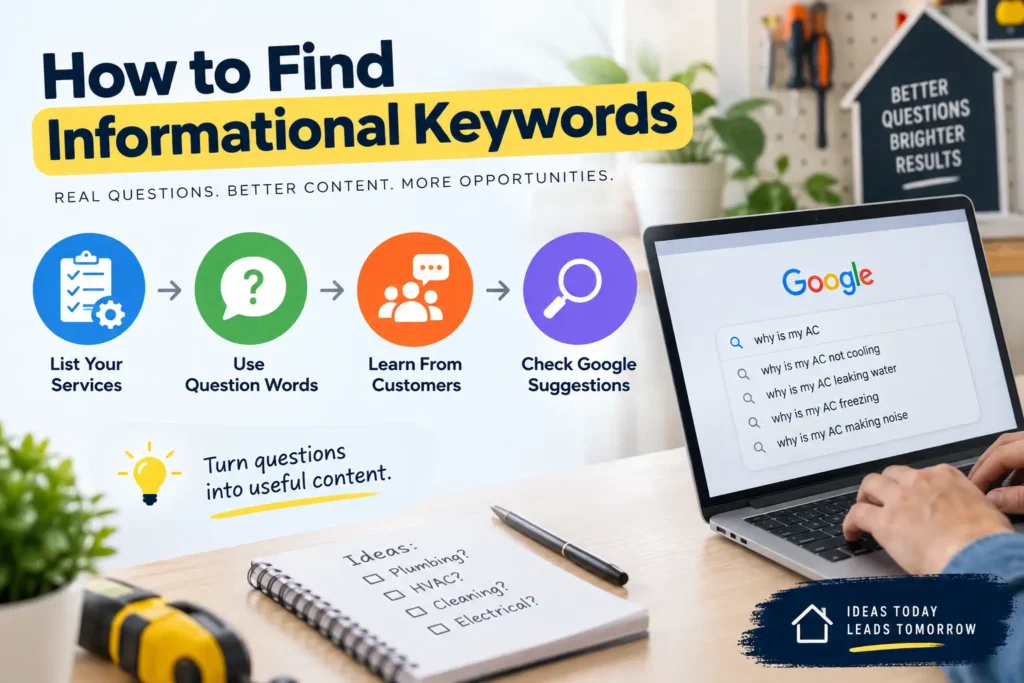
1. Start With Your Services
Make a list of your core services.
For a USA plumbing company:
- drain cleaning
- water heater repair
- sewer line repair
- pipe repair
- leak detection
- faucet repair
For a UAE HVAC company:
- AC repair
- AC installation
- AC maintenance
- duct cleaning
- split AC service
- central AC repair
Then turn each service into questions.
For water heater repair, try:
- Why is my water heater leaking?
- How long does a water heater last?
- How often should a water heater be serviced?
- Why is my water heater not producing hot water?
- Can a leaking water heater be repaired?
For AC maintenance, try:
- How often should AC be serviced?
- What happens during AC maintenance?
- Why is my AC not cooling?
- How do I clean an AC filter?
- Can dirty filters increase energy use?
2. Use Question Words
Question words are an easy starting point.
| Question | Example |
|---|---|
| What | What is duct cleaning? |
| Why | Why is my AC leaking water? |
| How | How do I unclog a drain? |
| When | When should I replace my roof? |
| Can | Can a plumber fix low water pressure? |
| Should | Should I repair or replace my water heater? |
| Is | Is mold caused by water leaks? |
| Does | Does AC maintenance save money? |
These questions also make good H2 and H3 headings.
3. Study Customer Questions
Your sales team and technicians can be excellent keyword research sources.
Ask them:
- What do customers ask before booking?
- What problems are most common?
- What mistakes do homeowners make?
- What do customers misunderstand?
- Which repairs are often delayed?
- Which maintenance tasks do customers forget?
A technician might say:
“Customers always ask why their AC is running but the house still feels hot.”
That is a content idea.
Turn it into:
Why Is My AC Running but Not Cooling the House?
Now you have a useful informational keyword and a real customer problem.
4. Use Google Search Suggestions
Start typing a basic phrase into Google.
For example:
“why is my AC…”
You may find variations such as:
- why is my AC not cooling
- why is my AC leaking water
- why is my AC freezing
- why is my AC making noise
These variations can become separate articles or subsections, depending on how closely related they are.
Google also provides related searches and other search features that can reveal the language people use.
USA Home Service Examples
Home service searches in the USA often vary by climate, housing type, and region.
A homeowner in Arizona may have different concerns from someone in Minnesota.
Plumbing Keywords
Examples include:
- how to unclog a kitchen sink
- why is my toilet running
- how to prevent frozen pipes
- why is my water pressure low
- how often should sewer lines be inspected
- what causes a slab leak
- how long does a water heater last
HVAC Keywords
Examples include:
- why is my AC not cooling
- how often should HVAC be serviced
- how often should I change my air filter
- why is my furnace blowing cold air
- what size AC unit do I need
- how much does AC replacement cost
- what causes an HVAC system to freeze
Roofing Keywords
Examples include:
- how long does a roof last
- what causes roof leaks
- how to find a roof leak
- when should I replace my roof
- how often should gutters be cleaned
- what does hail damage look like
A homeowner in Texas, for example, may search about storm damage or intense summer cooling needs.
A homeowner in New England may have stronger interest in heating, snow, ice, and frozen pipes.
That is why location plus problem can create useful informational keyword variations.
UAE Home Service Examples
The UAE has its own home service search patterns.
The climate plays a major role. Air conditioning, cooling, humidity, water systems, and indoor maintenance are common topics.
AC and HVAC Keywords
Examples include:
- why is my AC not cooling in Dubai
- how often should AC be serviced in Dubai
- why is my split AC leaking water
- how to clean AC filters
- how often should AC filters be changed
- why does my AC smell bad
- how much does AC maintenance cost in Dubai
- what causes high AC electricity bills
Plumbing Keywords
Examples include:
- why is my water pressure low
- why is my water heater leaking
- how to fix a blocked drain
- how often should water tanks be cleaned
- what causes bathroom pipe leaks
- how to prevent drain blockages
Cleaning Keywords
Examples include:
- how often should a villa be deep cleaned
- what is included in deep cleaning
- how to remove mold from bathroom walls
- how often should a sofa be professionally cleaned
- how to clean AC vents
For UAE content, location-specific context can make an article much more useful.
A general article might explain why AC units leak water.
A Dubai-focused article can also discuss the local climate, heavy AC use, indoor humidity, filters, drainage lines, and routine maintenance.
Informational Keyword Examples by Service
Here is a practical keyword bank you can use when building a home service content plan.
| Service | Informational keyword examples |
|---|---|
| Plumbing | why is my faucet leaking, how to unclog a drain |
| HVAC | why is my AC not cooling, how often should AC be serviced |
| Roofing | how long does a roof last, what causes roof leaks |
| Electrical | why does my breaker keep tripping, how does a circuit breaker work |
| Cleaning | how often should a house be deep cleaned |
| Pest control | what attracts cockroaches, how to prevent termites |
| Landscaping | how often should grass be watered |
| Garage doors | why won’t my garage door open |
| Water heaters | why is my water heater leaking |
| Mold removal | what causes mold in bathrooms |
| Air ducts | how often should air ducts be cleaned |
| Pool service | how often should a swimming pool be cleaned |
How to Turn Informational Keywords Into Content
Finding a keyword is only the beginning.
The next step is creating a page that actually answers the question.
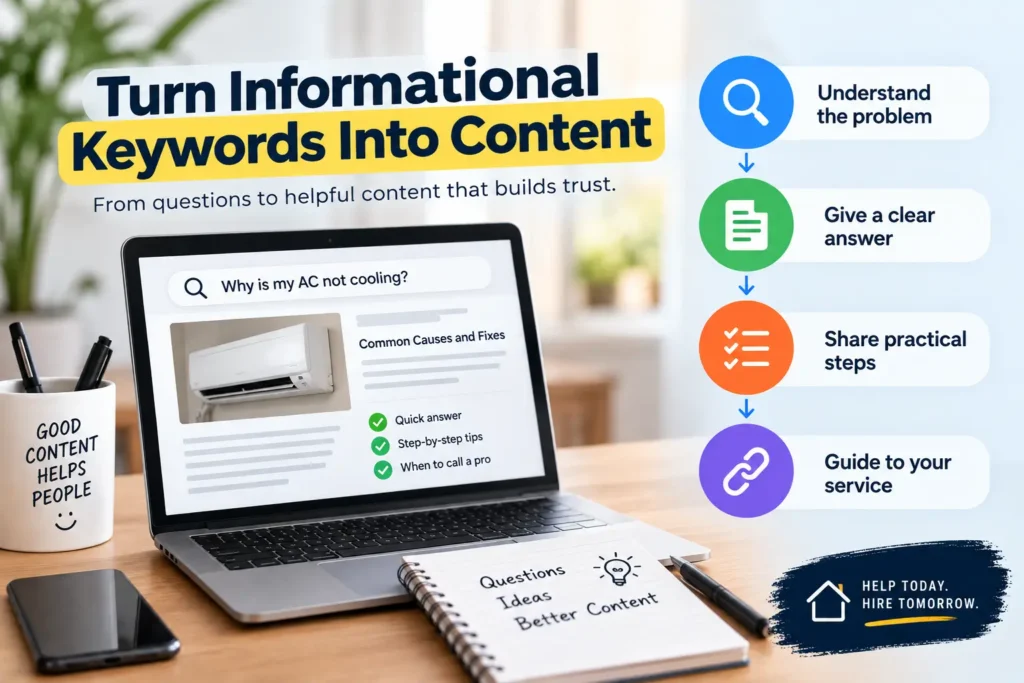
Step 1: Identify the Real Problem
Do not start by asking:
“How many times can I use this keyword?”
Ask:
“What does this person actually need to know?”
For “why is my AC not cooling?”, the reader probably wants:
- possible causes
- simple checks
- warning signs
- troubleshooting steps
- when to call a technician
- possible repair costs
- prevention tips
That should shape the article.
Step 2: Answer the Question Early
Do not make the reader scroll through five paragraphs before getting an answer.
Start with something like:
Quick answer: An AC may stop cooling because of a dirty filter, blocked airflow, low refrigerant, a faulty thermostat, frozen coils, or a mechanical problem.
Then explain each possibility.
This format is useful for readers and makes the main answer easy to understand.
Step 3: Add Practical Steps
Suppose the topic is:
How to Unclog a Bathroom Sink
A useful article could include:
- Remove visible debris.
- Clean the stopper.
- Try hot water if appropriate.
- Use a suitable plunger.
- Check the drain trap.
- Stop if there is a serious blockage or leak.
- Call a plumber when DIY steps do not work.
The goal is not to sound technical.
The goal is to help someone safely understand the problem.
Step 4: Connect the Article to a Service
The service connection should feel natural.
For example:
“If the drain remains blocked after basic cleaning, a professional drain cleaning service can inspect the pipe and locate deeper blockages.”
That is much better than adding:
“CALL US NOW FOR THE BEST DRAIN CLEANING SERVICE!!!”
Google warns against content that uses keywords unnaturally or creates pages mainly to manipulate rankings. Google for Developers
Informational Keyword Content Structure
A simple structure works well for most home service topics.
Recommended Article Layout
H1: Why Is My AC Not Cooling? Common Causes and Fixes
Introduction
Short explanation of the problem.
Quick Answer
One concise answer.
Key Takeaways
Three to five important points.
H2: Why Is My AC Not Cooling?
Explain the common causes.
H3: Dirty Air Filter
Explain how airflow becomes restricted.
H3: Low Refrigerant
Explain the basic warning signs.
H3: Frozen Evaporator Coil
Explain why ice can form.
H2: What Can You Check Yourself?
Give safe troubleshooting steps.
H2: When Should You Call an HVAC Technician?
Explain warning signs.
H2: How Can You Prevent AC Cooling Problems?
Give maintenance advice.
H2: Frequently Asked Questions
Answer related questions.
H2: Final Verdict
Summarize the main point.
Common Mistakes With Informational Keywords
Informational content can go wrong even when the keyword is correct.
Keyword Stuffing
Using the phrase “AC repair Dubai” 20 times does not make an article better.
It can make the writing awkward.
Instead, use natural related language:
- air conditioning repair
- AC technician
- cooling system
- split AC
- central AC
- AC maintenance
- indoor temperature
- airflow
- refrigerant
- air filter
Writing for Search Engines Instead of People
A paragraph like this is difficult to read:
“AC repair Dubai provides Dubai AC repair services for AC repair Dubai customers needing Dubai AC repair.”
It sounds unnatural.
Write like a person:
“If your AC is not cooling your home, check the filter and thermostat first. If the problem continues, an HVAC technician can inspect the system.”
Creating Too Many Nearly Identical Pages
A business does not need separate pages for every tiny keyword variation.
For example:
- why is my AC not cooling
- why isn’t my AC cooling
- AC not cooling why
- AC is not cooling reasons
These may all represent the same search intent.
One strong article may serve them better.
Google also warns about scaled content created primarily to manipulate search rankings without providing meaningful value.
Informational Keyword Content Checklist
Before publishing an article, ask these questions.
Search Intent Checklist
- Does the article answer the main question?
- Is the answer near the beginning?
- Does the content match the searcher’s problem?
- Are related questions covered?
- Is the information easy to scan?
- Are examples included?
- Are instructions clear?
- Are safety limits explained where needed?
- Is the local context useful?
- Does the article naturally connect to a relevant service?
SEO Checklist
- Primary keyword appears naturally.
- H1 clearly describes the topic.
- H2 and H3 headings follow a logical order.
- Related terms are used naturally.
- Title matches search intent.
- Meta description explains the benefit.
- Images have useful alt text.
- Internal links point to related service pages.
- No keyword stuffing.
- No unnecessary repetition.
How Informational Keywords Support Local SEO
Informational content can support local SEO when the location genuinely changes the answer.
Consider these two searches:
“How often should AC be serviced?”
and
“How often should AC be serviced in Dubai?”
The second query provides local context.
A UAE HVAC article could discuss heavy cooling demand, common AC systems, filter maintenance, drainage issues, and local service considerations.
A USA article could adapt the advice to regional climate and HVAC usage.
The same principle applies to:
- plumbing
- roofing
- heating
- pest control
- landscaping
- pool maintenance
- cleaning
- electrical services
The key is to add real local information, not simply insert a city name into every paragraph.
Pros and Cons of Informational Keywords
| Pros | Cons |
|---|---|
| Attract people looking for answers | Many visitors may not be ready to buy |
| Builds topical authority | Some topics have high competition |
| Creates useful blog content | Requires research and maintenance |
| Supports internal linking | Traffic does not always equal leads |
| Can introduce new customers to a brand | Poor content can attract the wrong audience |
| Works well with question-based searches | Some keywords have low commercial intent |
A good strategy is not to choose between informational and commercial content.
Use them together.
An informational article can educate the reader, while a service page gives them a clear next step when they are ready.
Expert Tips for USA and UAE Home Service Content
Answer Real Customer Questions
Your technicians hear useful questions every day.
Use those questions as content ideas.
Use Local Examples
A roofing article for Florida should not read exactly like one for Colorado.
A Dubai AC article should not be a copy of a generic US HVAC article.
Explain Before You Sell
Teach the reader what is happening.
Then explain when professional service makes sense.
Add Cost Context Carefully
Cost depends on location, equipment, labor, damage, materials, and job complexity.
Instead of promising one fixed price, explain what affects the price.
Show the Problem Visually
A photo of a clogged filter can be more useful than three paragraphs describing one.
Use diagrams, before-and-after photos, equipment photos, and screenshots where appropriate.
Frequently Asked Questions
Is “how to fix a leaking faucet” an informational keyword?
Yes. The searcher is asking for instructions. They may eventually hire a plumber, but their immediate goal is to understand how to solve the leaking faucet problem.
Can informational keywords generate home service leads?
Yes. They can introduce potential customers to a business before they are ready to buy. Strong content can then guide readers toward a relevant service page or contact option.
Should local businesses use informational keywords?
Yes, when the information has genuine local relevance. A Dubai AC maintenance article or a Texas roof repair guide can address local climate, housing, regulations, or common service needs.
Why are question keywords useful?
Question keywords closely match how people search when they need help. Words such as “why,” “how,” “what,” “when,” and “can” often reveal a clear information need.
Does keyword stuffing improve informational content?
No. Repeating a keyword excessively can make content difficult to read and may violate Google’s spam policies. Use the main term naturally and cover related concepts instead.
Key Takeaways
- Informational keywords answer questions.
- They usually target people earlier in the buying process.
- They are useful for plumbing, HVAC, roofing, electrical, cleaning, pest control, landscaping, and other home services.
- A good informational page should solve the reader’s problem first.
- USA and UAE searches often have different local needs.
- Informational content should naturally connect readers to relevant services.
- Avoid repeating keywords just to rank. Google specifically warns against keyword stuffing. Google for Developers
Final Verdict: Use Informational Keywords Naturally
Informational keywords give home service businesses a simple way to answer the questions people ask before they hire.
A plumber can explain why a drain keeps clogging.
An HVAC company can explain why an AC is not cooling.
A roofing company can explain what a roof leak looks like.
A UAE cleaning company can explain when a villa needs deep cleaning.
The best approach is simple: find real questions, give clear answers, add useful local context, and connect the reader to the right service when it makes sense.
Do not write for a keyword counter.
Write for the person standing in front of a leaking sink, a hot room, a blocked drain, or a damaged roof and asking, “What do I do now?”
That is where informational content becomes genuinely useful.
References:
Google Search Central: Creating Helpful, Reliable, People-First Content
Google Search Central: Spam Policies for Google Web Search
Google Search Central: SEO Starter Guide
Google Search Central: Introduction to Structured Data Markup
Google Trends: Explore What the World Is Searching