

If you run a plumbing, HVAC, cleaning, roofing, pest control, or handyman business, learning how to do SEO can help more local customers find you when they need your service.
Think about a homeowner with a leaking pipe at 10 p.m. They grab their phone and search, “emergency plumber near me.” SEO helps your business show up when that search happens.
What Is SEO?
SEO, or search engine optimization, is the process of improving a website so search engines can understand it and people can find useful pages through search.
For a home service business, SEO usually means making your website, business information, content, and online reputation strong enough to appear for searches related to your services and service areas.
SEO is not about putting the same keyword on a page 100 times.
It is about making the right information easy for Google and customers to understand.
Quick Answer
To do SEO, start by understanding what your customers search for. Then create useful pages around those searches, improve your website, optimize your Google Business Profile, build relevant links and mentions, and measure results in Google Search Console.
For a local home service company, the basic process looks like this:
- Define your services and service areas.
- Research customer search terms.
- Map keywords to the right pages.
- Optimize your website.
- Create useful service and location content.
- Optimize your Google Business Profile.
- Earn relevant reviews and local mentions.
- Build trustworthy backlinks.
- Fix technical SEO problems.
- Track clicks, impressions, queries, and leads.
- Improve pages based on real data.
Key Takeaways
- SEO helps customers discover your business through unpaid search results.
- Local SEO matters heavily for service businesses.
- Each important service should have a clear page.
- Location pages should provide real local value, not copied city names.
- Google Business Profile is important for local visibility.
- Good reviews can support your local presence and help customers choose a business.
- Internal links help visitors and search engines discover related pages.
- Search Console helps you understand which queries and pages are getting impressions and clicks.
- Avoid keyword stuffing, copied content, fake reviews, and spammy backlinks.
- SEO takes time, so measure progress instead of expecting overnight results.
How to Do SEO Step by Step
SEO becomes much easier when you stop treating it like a mystery.
Think of it like running a home service company. First, you decide what you sell. Then you figure out who needs it. Then you make it easy for those people to contact you.
Step 1: Understand Your Customer
Start with the customer, not the keyword tool.
Ask what someone would type into Google when they need your service.
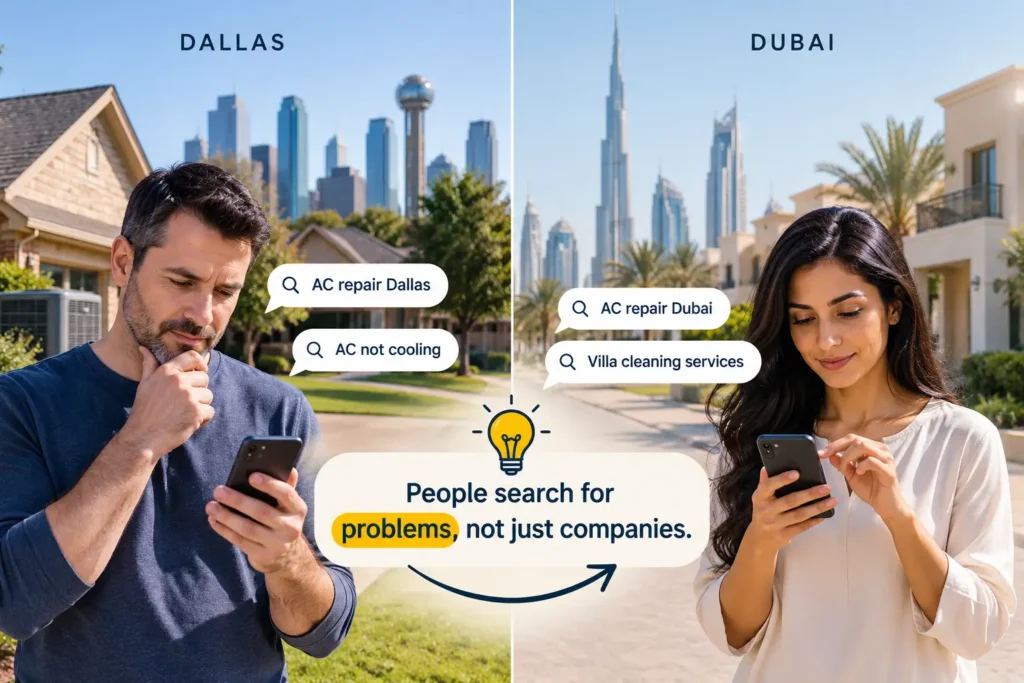
A homeowner in Dallas may search:
- “AC repair Dallas”
- “HVAC company near me”
- “air conditioner not cooling”
- “emergency AC repair”
- “AC repair cost”
- “best HVAC company in Dallas”
A homeowner in Dubai may search:
- “AC repair Dubai”
- “emergency plumber Dubai”
- “villa cleaning services Dubai”
- “water heater repair Dubai”
- “pest control company Dubai”
Notice something important.
People do not always search for a company. They often search for a problem.
That gives you more SEO opportunities.
Step 2: Find the Right Keywords
Keyword research is simply finding the words and questions your customers use in search.
Do not focus only on keywords with large search volumes.
A small keyword can still bring a customer who is ready to buy.
For example, “home cleaning” may be broad.
“Move out cleaning service in Austin” is much more specific.
The second search may have fewer searches, but the person behind it has a clear need.
Useful Keyword Types
| Keyword type | Example | Search intent |
|---|---|---|
| Service | AC repair | Find a service |
| Local | AC repair Houston | Find a local provider |
| Emergency | emergency plumber near me | Immediate need |
| Problem | AC blowing warm air | Find a solution |
| Cost | AC repair cost | Research pricing |
| Commercial | commercial HVAC repair | Business service |
| Informational | how often should AC filters be changed | Learn |
| Comparison | HVAC repair vs replacement | Compare options |
Use a mix of these terms throughout your SEO strategy.
Step 3: Build a Keyword Map
A keyword map tells you which keyword or topic belongs on which page.
This prevents your website from having ten pages all competing for the same search.
For example, an HVAC company might structure its website like this:
| Page | Main topic |
|---|---|
| Homepage | HVAC company |
| AC repair | AC repair services |
| AC installation | AC installation |
| Furnace repair | Furnace repair |
| Emergency HVAC | Emergency HVAC service |
| HVAC maintenance | HVAC maintenance |
| Service areas | Cities and neighborhoods served |
| Blog | Helpful HVAC questions |
This structure is also useful for customers.
Someone looking for AC repair does not have to dig through your homepage to find the service.
Step 4: Create Strong Service Pages
Your service pages are often some of the most important pages on a home service website.
A good service page should answer the customer’s main questions quickly.
For example, an AC repair page could explain:
- What the service includes
- Common AC problems
- Warning signs
- How the repair process works
- Typical factors that affect cost
- Service areas
- Emergency availability
- Why customers choose the company
- Reviews or customer experiences
- Frequently asked questions
- How to request service
Do not write 2,000 words just because a competitor has 2,000 words.
Write enough to answer the customer’s questions properly.
Step 5: Optimize Your Page Titles and Headings
Your page title helps describe the page to search engines and users.
Keep it clear.
Instead of:
Welcome to Our Amazing HVAC Company
Try:
AC Repair in Dallas, TX | ABC HVAC
Your H1 should also clearly describe the page.
For example:
AC Repair in Dallas, TX
Then use H2 and H3 headings to organize the information.
Example:
AC Repair Services in Dallas
Common AC Problems We Fix
How Our AC Repair Process Works
When Should You Call an HVAC Technician?
Clear headings make a page easier to scan.
They also help search engines understand the structure of your content.
Step 6: Make Your Website Easy to Use
SEO is not only about keywords.
Imagine finding a plumber through Google, clicking the website, and waiting 12 seconds for the page to load.
Then you see tiny text.
Then you cannot find the phone number.
You probably leave.
A service website should make the next step obvious.
Make sure visitors can quickly find:
- Phone number
- Quote request form
- Service list
- Service areas
- Business hours
- Emergency service information
- Reviews
- Address or service location information
- Clear calls to action
Mobile usability matters too.
Many local service searches happen when someone is already out and about or dealing with a problem at home.
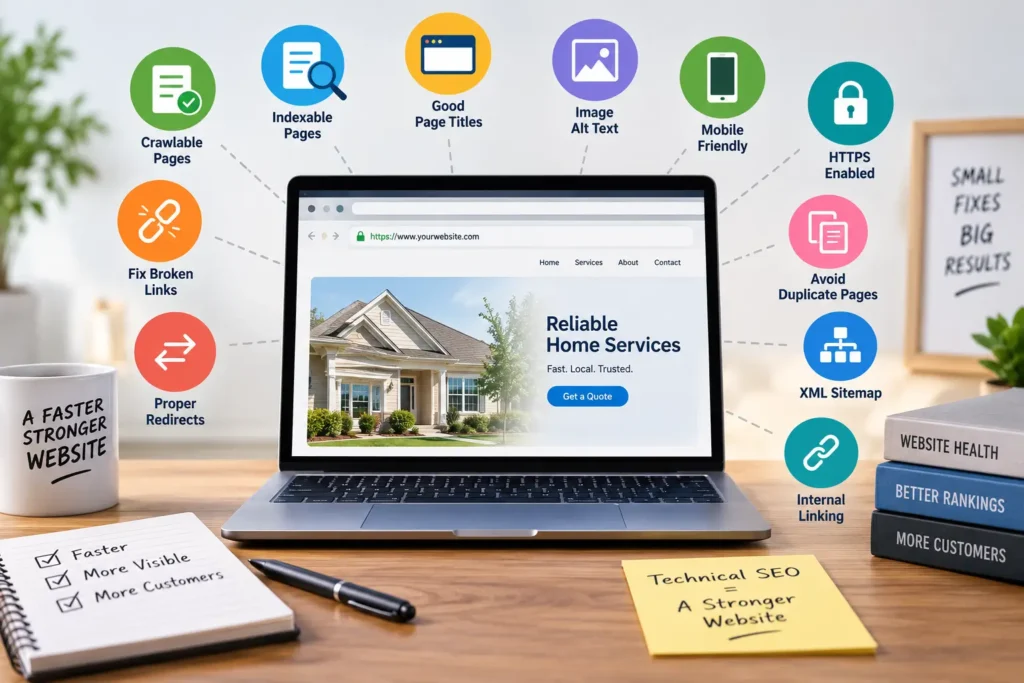
Step 7: Improve Technical SEO
Technical SEO is the part that helps search engines access, understand, and process your website.
You do not need to be a programmer to understand the basics.
Check that:
- Important pages can be crawled.
- Important pages can be indexed.
- Pages have useful titles.
- Images have descriptive alt text when appropriate.
- Your site works on mobile devices.
- HTTPS is enabled.
- Broken links are fixed.
- Redirects are handled properly.
- Duplicate pages are controlled.
- Your XML sitemap is available when appropriate.
- Important pages are linked internally.
- Your site does not have unnecessary technical barriers.
A beautiful website is not useful if search engines cannot properly access its important pages.
How to Do Local SEO for Home Services
Local SEO helps a business appear when people search for services in a particular area.
For a plumber, roofer, cleaner, electrician, or HVAC company, this can be one of the most valuable parts of SEO.
Optimize Your Google Business Profile
Your Google Business Profile connects your business with Google Search and Google Maps.
Complete the profile accurately.
Use your real business information.
Pay attention to:
- Business name
- Primary category
- Secondary categories when relevant
- Phone number
- Website
- Hours
- Service areas
- Services
- Photos
- Business description
- Reviews
- Attributes where applicable
Google says local results are mainly influenced by relevance, distance, and prominence. Google also recommends keeping Business Profile information complete and accurate.
Do not try to manipulate the profile by stuffing city names or keywords into the business name.
Use your actual business name.
Build Local Relevance
Suppose you run a roofing company in Phoenix.
A page saying:
“Roofing services in Phoenix”
is not enough by itself.
Add useful local information.
You might explain:
- Common roofing problems in the area
- Roof inspection services
- Types of roofs you work on
- Storm damage repair
- What homeowners should check after severe weather
- Neighborhoods or communities you genuinely serve
- Local project examples
The key word is genuinely.
Do not create 50 nearly identical pages just to put different city names into the title.
Google’s spam policies specifically warn against doorway pages and scaled content created mainly to manipulate search rankings.
Get Genuine Customer Reviews
Reviews matter for two reasons.
First, people read them.
Second, Google uses information such as reviews and links as part of understanding local business prominence.
Ask real customers for honest reviews after completed jobs.
Do not buy fake reviews.
Do not write fake reviews for your own business.
Do not offer misleading incentives for positive reviews.
A better approach is simple:
“Thanks for choosing us. If you were happy with the service, we’d appreciate an honest review.”
Then make the review process easy.
How to Do Keyword Research for SEO
Keyword research becomes easier when you group searches by customer intent.
Think about the questions someone asks before, during, and after buying a service.
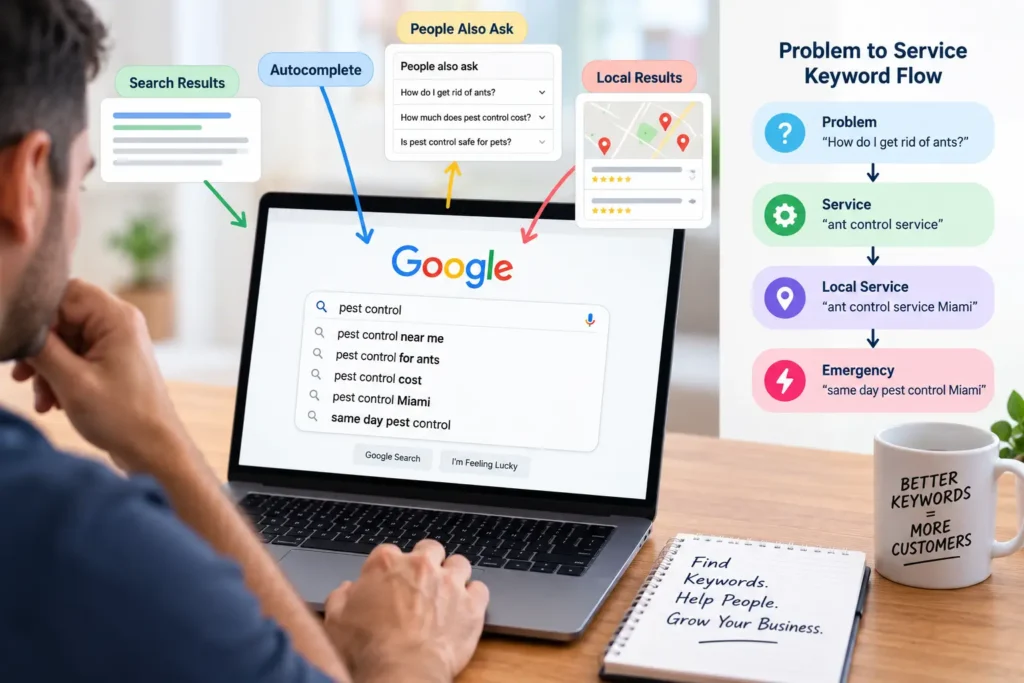
Use the Problem-to-Service Method
Start with problems.
For a pest control company:
Problem: “How do I get rid of ants?”
Then move toward commercial intent:
Service: “ant control service”
Then local intent:
Local service: “ant control service Miami”
Then urgent intent:
Emergency: “same day pest control Miami”
One customer journey can create several useful content opportunities.
Use Google’s Own Search Results
Search your main service yourself.
Look at:
- Autocomplete suggestions
- Related searches
- People Also Ask questions
- Local results
- Competitor service pages
- Featured snippets
- Search result titles
The goal is not to copy competitors.
Look for questions they fail to answer.
That is where useful content opportunities often appear.
How to Do On-Page SEO
On-page SEO means improving the content and elements on your own website.
It includes more than adding keywords.
Optimize the Main Elements
For each important page, check:
- Page title
- H1
- H2 and H3 headings
- Introduction
- Main service information
- Internal links
- Images
- Image alt text where useful
- URL
- Meta description
- Calls to action
- Structured data when appropriate
Use your focus keyword naturally.
For example, if your focus keyword is how to do SEO, you could use it in the title and introduction.
But you do not need to repeat it in every paragraph.
Write for Humans First
Imagine your customer is standing in front of you.
Would you explain the service using the same words you put on the website?
If not, rewrite it.
Instead of:
“Our highly trained professionals leverage cutting-edge solutions to optimize your residential climate environment.”
Say:
“Our HVAC technicians diagnose the problem, explain the repair, and help you understand your options.”
The second version sounds like a real business.
How to Do Off-Page SEO
Off-page SEO involves signals and mentions that happen outside your website.
Links are one example.
But not every backlink is useful.
Build Relevant Backlinks
A local plumber might earn useful links from:
- Local business organizations
- Trade associations
- Community organizations
- Local news websites
- Suppliers
- Manufacturers
- Local sponsorships
- Industry publications
- Relevant directories
Relevance matters.
A random website selling unrelated products is not a natural match for a plumbing business.
Avoid buying large batches of low-quality links.
Google’s spam policies identify link spam as a practice intended to manipulate rankings, including buying or selling links for ranking purposes.
Use Local Citations Carefully
A citation usually includes information such as:
- Business name
- Address
- Phone number
- Website
Keep important business details consistent.
But do not spend all your time submitting your business to hundreds of random directories.
Focus on directories and platforms that customers actually use or that are relevant to your industry and location.
How to Create SEO Content That Gets Read
A home service blog should answer real customer questions.
Do not publish articles just because a keyword tool says a phrase has search volume.
Ask:
Would a real customer find this useful?
Good Home Service Content Ideas
A plumbing company could publish:
- Why does my water heater keep shutting off?
- How much does a water heater replacement cost?
- What causes low water pressure?
- When should you replace a water heater?
- How to shut off your home’s main water supply
An HVAC company could publish:
- Why is my AC blowing warm air?
- How often should you change an HVAC filter?
- How long does an AC unit last?
- Repair or replace: which makes more sense?
- Why is my HVAC system making a strange noise?
A cleaning company could publish:
- What is included in a deep house cleaning?
- How long does move-out cleaning take?
- How often should you deep clean your home?
- What should you clean before selling a house?
A UAE home service business could create content around apartment cleaning, villa maintenance, AC servicing, water tank cleaning, pest control, and move-in or move-out services.
How to Do Internal Linking
Internal links connect pages on your own website.
They help visitors move from one useful page to another.
They also help search engines discover relationships between pages.
For example, an HVAC article about “Why Is My AC Not Cooling?” could link naturally to:
- AC repair services
- AC maintenance
- Emergency HVAC service
- AC installation
- HVAC service areas
Use descriptive anchor text.
Instead of:
Click here
use:
learn more about our AC repair service
The reader knows what they will find before clicking.
How to Use Structured Data
Structured data is code that helps search engines understand information on a page.
For a local business, this can include details such as business type, name, address, phone number, URL, and other relevant information.
Google provides specific documentation for LocalBusiness structured data.
Structured data does not mean Google will automatically give you a higher ranking.
Its main purpose is to help search engines understand eligible content and information.
Useful Schema Types
Depending on the website, relevant Schema.org types may include:
- Organization
- LocalBusiness
- Service
- BreadcrumbList
- Article
- WebPage
- FAQPage where applicable
- ImageObject
Use only markup that accurately represents visible and relevant information.
Do not add fake reviews, fake prices, or information that does not appear on the page.
How to Measure SEO Results
SEO without measurement is like sending a technician to a house without checking the problem.
You need data.
Google Search Console can show clicks, impressions, CTR, average position, queries, pages, countries, devices, and other search performance information.
Watch These SEO Metrics
| Metric | What it tells you |
|---|---|
| Impressions | How often your result appeared |
| Clicks | How many people visited from search |
| CTR | How often impressions resulted in clicks |
| Average position | The average position reported for your site’s topmost result |
| Queries | What people searched |
| Landing pages | Which pages appeared in search |
| Leads | Whether SEO traffic becomes business |
Do not obsess over one ranking number.
A page moving from position 8 to 4 can be useful, but what matters to the business is whether visibility, clicks, calls, quote requests, and customers improve.
Google itself recommends using Search Console to understand queries, pages, clicks, impressions, CTR, and search trends.
Find SEO Opportunities in Search Console
Look for pages that already receive impressions but few clicks.
For example:
A page receives 8,000 impressions and 120 clicks.
That does not automatically mean something is wrong.
But it gives you a reason to inspect:
- Search queries
- Page title
- Search intent
- Content quality
- Competitor results
- Page relevance
You may discover that the page appears for searches you did not originally target.
That can give you ideas for improving the page.
Common SEO Mistakes to Avoid
Most SEO problems are not caused by a lack of effort.
They often come from doing the wrong things repeatedly.
Keyword Stuffing
Do not write:
“Dallas plumber, best Dallas plumber, Dallas plumbing company, Dallas plumbing service, cheap Dallas plumber…”
That sounds unnatural.
Use the terms where they make sense.
Creating Hundreds of Thin Location Pages
A business serving 20 cities does not necessarily need 20 almost identical pages.
If you create location pages, make each one genuinely useful.
Include real service information, local context, relevant projects, and information that helps customers in that area.
Copying Competitor Content
Do not copy another company’s service pages and replace a few words.
Create your own explanations.
Use your own experience.
Add real examples.
Buying Spammy Backlinks
More links do not automatically mean better SEO.
A few relevant and trustworthy mentions can be more useful than thousands of random links.
Ignoring Conversion Optimization
Getting traffic is only part of the job.
If 1,000 people visit your service page but nobody calls, requests a quote, or books an appointment, you have a business problem to investigate.
Make your next step clear.
SEO Checklist for a Home Service Business
Use this checklist before launching or updating your website.
Website Checklist
- HTTPS works correctly
- Website works well on mobile
- Important pages can be indexed
- Service pages are easy to find
- Page titles are descriptive
- H1 headings are clear
- Images are useful and optimized
- Internal links connect related pages
- Contact information is easy to find
- Calls to action are clear
- Broken links are fixed
- Sitemap is available where appropriate
Local SEO Checklist
- Google Business Profile is claimed and verified
- Business name is accurate
- Category is relevant
- Services are listed
- Hours are accurate
- Website and phone number are correct
- Photos are added
- Customers can leave genuine reviews
- Reviews receive appropriate responses
- Local business information is consistent
Content Checklist
- Every major service has a useful page
- Content answers customer questions
- Content is original
- Examples are practical
- Pages match search intent
- Keywords are used naturally
- Content is easy to scan
- FAQs answer real customer questions
- Content is updated when information changes
SEO Examples: USA vs. UAE Home Services
The basic SEO process stays the same, but customer behavior and local context can differ.
| Business | USA example | UAE example |
|---|---|---|
| HVAC | AC repair in Houston | AC servicing in Dubai |
| Plumbing | Emergency plumber in Phoenix | Plumber in Abu Dhabi |
| Cleaning | House cleaning in Austin | Villa cleaning in Dubai |
| Pest control | Pest control in Miami | Pest control in Sharjah |
| Roofing | Roof repair in Dallas | Roof maintenance in Dubai |
| Handyman | Handyman services in Tampa | Handyman services in Dubai |
The lesson is simple.
Do not copy an SEO strategy from another market word for word.
Study how your own customers search.
Expert Tips for Better SEO
Small improvements can make your SEO process much easier.
Tip 1: Start With Money Pages
Do not spend six months blogging before fixing your service pages.
Start with the pages that can generate customers.
Tip 2: Solve Problems, Not Just Keywords
“Water heater repair” is a service.
“Why does my water heater keep turning off?” is a customer problem.
Good SEO can address both.
Tip 3: Use Real Business Experience
If your technicians see the same problem every week, write about it.
That experience gives your content something generic articles cannot easily copy.
Tip 4: Keep Updating Important Pages
If your service changes, update the page.
If your hours change, update them.
If you stop offering a service, remove or redirect the relevant page.
Tip 5: Think Beyond Google
Customers may discover businesses through Google Search, Google Maps, social platforms, review websites, local directories, referrals, and other channels.
Your website should make the business easy to understand wherever customers find you.
Frequently Asked Questions
What is the easiest way to learn SEO?
Start with the basics: search intent, keyword research, on-page SEO, technical SEO, local SEO, links, and measurement. Then practice on a real website and study what happens.
Is SEO free?
SEO does not require paying Google for organic rankings. However, businesses may spend money on website development, content, tools, technical work, photography, link outreach, or professional SEO services.
Can a small home service business do SEO?
Yes. A small business can start with its service pages, Google Business Profile, useful local content, reviews, internal links, and basic technical SEO. You do not need a huge website to begin.
Should every service have its own page?
Usually, important services deserve clear pages when they represent distinct customer needs. A page should exist because it is useful, not simply because you want another URL to rank.
Why is my website not ranking on Google?
Possible causes include weak relevance, poor content, technical indexing problems, weak local signals, strong competition, poor site structure, or a mismatch between the page and the searcher’s intent.
When should I expect SEO results?
There is no universal timeline. Results depend on competition, website history, content quality, technical condition, location, authority, and the work being done. Measure progress over time rather than expecting an exact deadline.
SEO Strategy for a New Home Service Website
If you are starting from zero, keep the first version simple.
You do not need 100 blog posts.
You need a strong foundation.
Month 1: Build the Foundation
Focus on:
- Website structure
- Homepage
- Core service pages
- Contact page
- About page
- Service areas
- Google Business Profile
- Search Console
- Analytics
- Basic technical SEO
Month 2: Build Relevance
Create useful content around:
- Customer problems
- Service questions
- Pricing questions
- Maintenance questions
- Emergency situations
- Local service needs
Improve internal linking.
Start earning legitimate local mentions and links.
Month 3 and Beyond: Improve
Review your Search Console data.
Find:
- Queries gaining impressions
- Pages gaining clicks
- Pages with weak CTR
- New search topics
- Pages losing visibility
- Services that need better content
Then improve the pages that have the clearest opportunities.
SEO becomes much more useful when it becomes a cycle:
Research → Create → Publish → Measure → Improve
Pros and Cons of SEO
SEO can be powerful, but it is not perfect.
Pros
- Can generate unpaid search traffic
- Can bring customers with strong buying intent
- Builds long-term website assets
- Helps customers discover useful information
- Supports local visibility
- Can reduce dependence on paid advertising over time
Cons
- Results can take time
- Competition can be strong
- Search behavior changes
- Poor SEO can waste time
- Rankings are not guaranteed
- SEO requires ongoing measurement and maintenance
The best approach is to treat SEO as part of your overall marketing system, not as a magic button.
Final Verdict: SEO Works Best When You Help People Find You!
Learning how to do SEO is less complicated when you stop thinking about Google first and start thinking about the customer.
A person searches because they want something.
They may need a plumber.
They may need a cleaner.
They may need an AC technician.
They may simply want to know why their water heater is leaking.
Your job is to create the clearest answer and make it easy for that person to take the next step.
For a home service business, start with the basics: strong service pages, useful content, local SEO, accurate business information, genuine reviews, technical health, relevant links, and regular measurement.
Do those things well.
Then use real search data to keep improving.
That is the foundation of sustainable SEO.
External SEO Sources
- Google Search Console metrics → Google Search Console Help
- Local SEO and Google Maps → Google Business Profile Help
- SEO fundamentals → Google Search Central
- Structured data → Schema.org
- Beginner SEO practices → Google SEO Starter Guide