


Keyword variations help you cover the different ways people search for the same service, product, or topic. They make content more natural and help search engines understand what your page is really about.
Imagine a homeowner in Texas searching for “AC repair near me.” Another person may type “air conditioner repair,” “HVAC technician,” or “AC service company.” The words change, but the need is almost the same.
That is where keyword variations become useful.
What Are Keyword Variations?
Keyword variations are different words or phrases that describe the same search topic, service, product, or user need. They can include synonyms, related phrases, long-tail keywords, location terms, and different search wording.
For example, a plumbing company might target:
- plumber near me
- local plumber
- plumbing services
- plumbing company
- emergency plumber
- plumbing repair
- residential plumber
- drain cleaning service
- water leak repair
These phrases are different, but they belong to the same topic.
Why Do Keyword Variations Matter?
People rarely search in exactly the same way.
One homeowner may search “garage door repair near me.” Another may search “fix broken garage door.” A third may search “garage door technician.”
If your page only uses one phrase repeatedly, it may sound awkward. It may also fail to answer related questions.
Keyword variations let you build a page around the whole topic instead of one exact phrase.
Types of Keyword Variations
Keyword variations come in several forms. Each type can help you understand how people search.
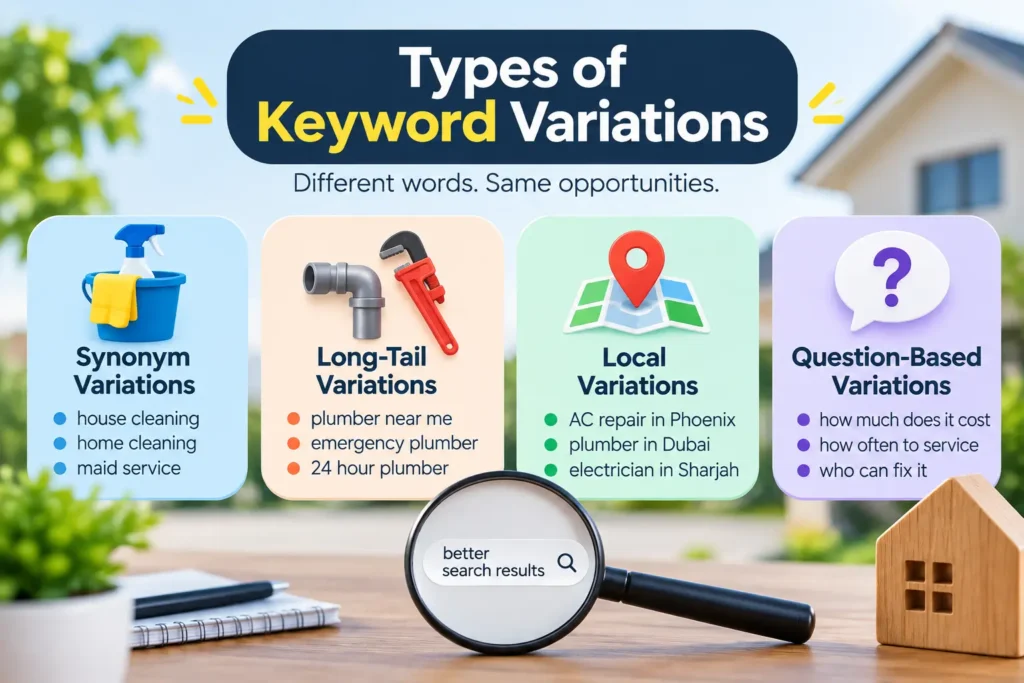
Synonym Variations
Synonyms use different words with similar meanings.
For example:
- house cleaning
- home cleaning
- residential cleaning
- maid service
- home cleaning service
These terms are related, but they are not always perfect substitutes.
A cleaning company in Dubai might use “home cleaning service” on its main service page and naturally mention “house cleaning,” “residential cleaning,” and “maid service” where appropriate.
Long-Tail Keyword Variations
Long-tail keywords are longer and more specific search phrases.
For example:
- plumber
- plumber near me
- emergency plumber near me
- emergency plumber in Houston
- 24 hour emergency plumber in Houston
The longer phrase usually gives more information about what the person wants.
A homeowner searching “24 hour emergency plumber in Houston” probably needs help now. Someone searching simply for “plumber” may still be researching.
Local Keyword Variations
Local keywords add a place to the search.
Examples include:
- AC repair in Phoenix
- HVAC repair in Dallas
- plumber in Miami
- home cleaning service in Dubai
- AC maintenance in Abu Dhabi
- electrician in Sharjah
- pest control in Dubai Marina
Local keywords are especially useful for home services because customers usually need a company that can physically reach their property.
Question-Based Variations
People also search using questions.
Examples:
- How much does AC repair cost?
- How often should an AC be serviced?
- How long does drain cleaning take?
- Who fixes a leaking water heater?
- Can a plumber repair a burst pipe?
- What is included in a deep cleaning service?
These phrases are useful for blog posts, FAQs, service pages, and support content.
Keyword Variations vs Related Keywords
These terms are closely connected, but they are not exactly the same.
Keyword variations are alternate ways of expressing the main keyword. Related keywords are terms that help describe the wider topic.
| Main Keyword | Keyword Variation | Related Keyword |
|---|---|---|
| AC repair | air conditioner repair | HVAC system |
| plumber | plumbing contractor | water heater |
| house cleaning | home cleaning | deep cleaning |
| pest control | pest removal | termites |
| electrician | electrical contractor | circuit breaker |
| roof repair | roofing repair | roof inspection |
Think of the main keyword as the center of a wheel.
Keyword variations sit close to the center. Related keywords help create the wider circle around the topic.
How to Find Keyword Variations
Finding variations does not have to be complicated. Start with the way a real customer would speak.
Step 1: Start With the Main Keyword
Choose the main topic first.
For example:
Main keyword: AC repair
Then ask:
“What else might a customer type into Google?”
Possible answers:
- AC repair near me
- air conditioner repair
- AC service
- AC technician
- HVAC repair
- residential AC repair
- emergency AC repair
- AC repair company
Step 2: Think Like the Customer
Forget SEO for a moment.
Imagine your air conditioner stops working on a hot afternoon.
What would you search?
You might type:
“AC not cooling”
Then:
“AC repair near me”
Then perhaps:
“emergency AC technician”
These are valuable keyword variations because they reflect real problems.
Step 3: Add Location Modifiers
Home services are strongly connected to location.
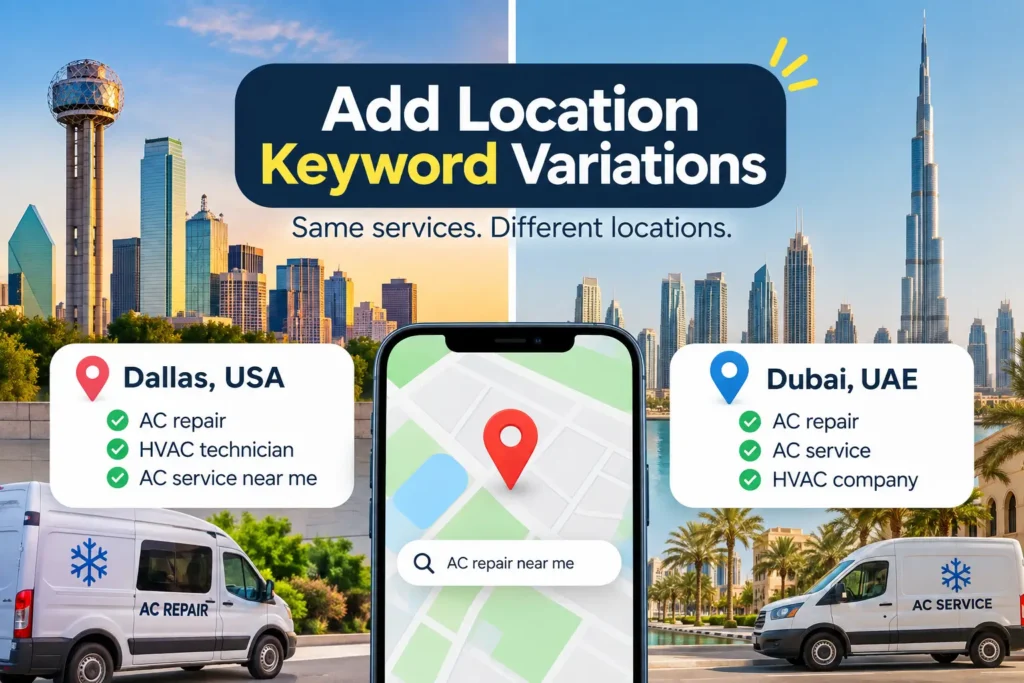
A business serving Dallas could use variations such as:
- AC repair Dallas
- air conditioner repair Dallas
- HVAC technician Dallas
- AC service near me
- residential HVAC repair Dallas
A Dubai company could use:
- AC repair Dubai
- AC service Dubai
- air conditioning maintenance Dubai
- HVAC company Dubai
- AC technician near me
- residential AC repair Dubai
Do not create dozens of nearly identical pages just by changing city names. Each location page should provide useful local information.
Step 4: Add Service Modifiers
Service modifiers make the search more specific.
For plumbing, examples include:
- emergency plumbing
- drain cleaning
- pipe repair
- water leak detection
- sewer line repair
- water heater repair
For cleaning:
- deep house cleaning
- move-out cleaning
- apartment cleaning
- sofa cleaning
- carpet cleaning
- post-construction cleaning
Step 5: Add Problem-Based Searches
Customers often search for the problem rather than the service.
For example:
Service: Refrigerator repair
Problem-based variations:
- refrigerator not cooling
- fridge leaking water
- freezer not freezing
- refrigerator making noise
- fridge ice maker not working
This is useful because the customer may not know the technical name for the repair.
Keyword Variations for USA Home Services
Home service searches in the USA often include service type, location, urgency, and property type.
Common USA Examples
| Service | Keyword Variations |
|---|---|
| Plumbing | plumber near me, emergency plumber, plumbing repair, local plumber |
| HVAC | AC repair, HVAC repair, air conditioner service, HVAC technician |
| Electrical | electrician near me, electrical repair, residential electrician |
| Roofing | roof repair, roofing contractor, roof replacement |
| Cleaning | house cleaning, home cleaning service, maid service |
| Pest Control | pest control near me, exterminator, termite control |
| Landscaping | lawn care, landscaping service, yard maintenance |
| Garage Doors | garage door repair, garage door replacement, broken garage door repair |
For example, a homeowner in Phoenix may search “AC repair Phoenix” after their air conditioner stops cooling.
Someone in Chicago may search “furnace repair near me” during winter.
The service is similar. The search wording changes with location and need.
Keyword Variations for UAE Home Services
UAE home-service searches can include city, community, property type, and specific service terms.
Common UAE Examples
| Service | Keyword Variations |
|---|---|
| AC | AC repair Dubai, AC maintenance Dubai, air conditioning service |
| Plumbing | plumber Dubai, plumbing company Dubai, emergency plumber |
| Cleaning | home cleaning Dubai, maid service Dubai, deep cleaning |
| Electrical | electrician Dubai, electrical maintenance, electrical repair |
| Pest Control | pest control Dubai, termite control, cockroach control |
| Handyman | handyman Dubai, home maintenance, handyman service |
| Painting | house painting Dubai, villa painting, interior painting |
| Water Tank | water tank cleaning Dubai, tank cleaning service |
For example, someone living in a Dubai apartment might search “AC service near me.”
A villa owner may search “villa maintenance company Dubai.”
The underlying need is home maintenance, but the search terms become more specific.
How Keyword Variations Support Search Intent
Search intent is the reason behind a search.
Two people can use similar keywords but have different goals.
Informational Intent
The person wants information.
Examples:
- how often should AC be serviced
- how to unclog a kitchen drain
- why is my AC leaking water
Useful content:
- blog posts
- guides
- FAQs
- troubleshooting pages
Commercial Investigation
The person is comparing options.
Examples:
- best AC repair company near me
- plumbing service prices
- home cleaning companies Dubai
- HVAC maintenance plans
Useful content:
- comparison pages
- service guides
- pricing explanations
- service-area pages
Transactional Intent
The person is ready to hire.
Examples:
- emergency plumber near me
- AC repair Dubai
- electrician in Houston
- deep cleaning service Abu Dhabi
Useful content:
- service pages
- booking pages
- contact pages
- location pages
Navigational Intent
The person wants a specific company or website.
Examples:
- ABC Plumbing Houston
- company name + phone number
- company name + services
The page should make it easy to find the business and its services.

How to Use Keyword Variations on a Web Page
Do not place every variation in one paragraph.
Use each phrase where it makes sense.
Use the Main Keyword in Important Places
Your primary keyword can appear in:
- H1
- introduction
- one or more relevant H2 headings
- page title
- meta description
- URL slug
- image alt text when descriptive
- body content
Do not repeat it just to increase keyword frequency.
Use Variations in Headings
Instead of repeating:
“AC Repair”
“AC Repair”
“AC Repair”
You can create useful headings such as:
- Emergency AC Repair
- Common Air Conditioner Problems
- When to Call an HVAC Technician
- AC Maintenance Tips
- How Much Does AC Repair Cost?
The page becomes easier to read and covers more related questions.
Use Variations Naturally in Examples
Suppose your main keyword is plumbing services.
A natural paragraph might say:
“Professional plumbing services can cover everything from leaking pipes and clogged drains to water heater repairs. If you have a burst pipe, an emergency plumber may be able to respond quickly.”
There is no need to repeat “plumbing services” in every sentence.
Keyword Variations for Local SEO
Local SEO helps businesses appear when nearby customers search for their services.
This matters a lot for plumbers, electricians, cleaners, HVAC companies, roofers, handymen, pest control companies, and other service providers.
Build Location-Relevant Content
A local service page can include:
- city name
- neighborhoods served
- service areas
- local property types
- common local problems
- business address when appropriate
- phone number
- operating hours
- service availability
- customer questions
For example, a Dubai AC company could discuss AC maintenance for apartments and villas.
A Texas HVAC company could discuss cooling systems used in hot summer weather.
The content should provide real local value instead of simply swapping one city name for another.
Common Mistakes With Keyword Variations
Keyword variations are helpful, but they can be misused.
Mistake 1: Keyword Stuffing
Keyword stuffing means adding keywords so often that the writing becomes unnatural.
Bad example:
“Looking for AC repair? Our AC repair company offers AC repair services for AC repair customers looking for AC repair.”
Nobody talks like that.
Write for the customer first.
Mistake 2: Using Unrelated Keywords
Do not add a keyword just because it has search volume.
A plumbing company should not add “roof replacement” simply because people search for it.
The keyword should match the service and page.
Mistake 3: Creating Duplicate Location Pages
A company serving 20 cities does not necessarily need 20 pages with the same text and only the city name changed.
Each useful location page should have meaningful local information.
Mistake 4: Ignoring Search Intent
A page targeting “how to fix a leaking faucet” should not immediately push users toward a booking form without answering the question.
Match the content to what the searcher wants.
Mistake 5: Chasing Every Synonym
Not every synonym needs its own page.
If two phrases have the same intent, one strong page can often cover both naturally.
Keyword Variation Checklist
Use this checklist when optimizing a page.
- Identify one primary keyword.
- List close keyword variations.
- Add relevant long-tail keywords.
- Identify customer problems.
- Add useful question-based searches.
- Add location terms when local SEO matters.
- Check search intent.
- Use variations naturally.
- Avoid keyword stuffing.
- Avoid irrelevant terms.
- Add examples and FAQs.
- Make the page useful without the keywords.
Expert Tips for Better Keyword Research
Good keyword research starts with customer language.
Use Real Customer Questions
Read:
- customer reviews
- support emails
- service requests
- sales calls
- online community questions
- Google search suggestions
- FAQ sections
Customers often describe their problems differently from marketers.
A company might say “HVAC system malfunction.”
A homeowner might say:
“My AC is blowing warm air.”
The second phrase can reveal a valuable content topic.
Group Keywords by Search Intent
Instead of making a giant keyword list, group phrases into topics.
For example:
AC repair
- AC repair near me
- air conditioner repair
- AC technician
- emergency AC repair
AC problems
- AC blowing warm air
- AC leaking water
- AC making noise
- AC not turning on
AC maintenance
- AC tune-up
- AC maintenance service
- air conditioner maintenance
- HVAC maintenance
This creates a cleaner content plan.
Do Not Treat Every Variation as a Separate Article
One strong article can answer several closely related searches.
For example, a page about “AC repair” could naturally cover:
- air conditioner repair
- common AC problems
- emergency AC service
- HVAC technician
- AC repair costs
- when to call a professional
Create separate pages when the search intent is meaningfully different.
Pros and Cons of Using Keyword Variations
| Pros | Cons |
|---|---|
| Makes content more natural | Too many terms can create clutter |
| Covers more search language | Poor variations can dilute relevance |
| Supports long-tail searches | Similar keywords may overlap |
| Helps answer customer questions | Keyword stuffing can hurt readability |
| Useful for local SEO | Duplicate location pages can be weak |
| Supports topical coverage | Not every synonym needs a separate page |
A Simple Example
Imagine you run a home maintenance company in Dubai.
Your main keyword is:
home maintenance Dubai
Instead of repeating that phrase throughout the page, build a natural topic around it.
You might discuss:
- home maintenance services
- apartment maintenance
- villa maintenance
- handyman services
- plumbing repairs
- electrical repairs
- AC maintenance
- emergency home repairs
- property maintenance
- residential maintenance
Now the page gives search engines and customers a much clearer picture of what the company actually does.
The same idea works in the USA.
A home services company in Houston might target “home maintenance Houston” and naturally discuss plumbing, electrical work, HVAC service, handyman repairs, and seasonal maintenance.
Frequently Asked Questions
What are keyword variations?
Keyword variations are different phrases people use to search for the same main topic. They can include synonyms, long-tail terms, questions, location phrases, and service-specific searches.
Is it necessary to use every keyword variation?
No. Use variations that genuinely match the topic and search intent. A few useful phrases are better than forcing dozens of similar keywords into one page.
Can keyword variations improve local SEO?
Yes. Relevant location and service variations can help explain where a business operates and what it offers. Local content should still provide useful information beyond simply naming a city.
Should each keyword variation have its own page?
Not usually. Closely related phrases with the same search intent can often be covered on one strong page. Separate pages make more sense when the intent or service is clearly different.
Why do home service businesses need keyword variations?
Home service customers use many different search phrases. One person may search for “plumber near me,” while another searches for “burst pipe repair.” Variations help businesses address these different needs.
When should you use long-tail keyword variations?
Use long-tail variations when the search is specific, such as “24 hour emergency plumber in Houston” or “villa AC maintenance Dubai.” They can be useful for pages that answer a focused customer need.
Key Takeaways
- Keyword variations are different versions of a main search term.
- They include synonyms, related keywords, long-tail keywords, and location-based phrases.
- They help cover different search intents.
- They make writing sound more natural.
- They are useful for local SEO and home service businesses.
- You should use them naturally, not force every variation into one page.
- Search intent matters more than simply adding more keywords.
Final Verdict: Use Keywords Like Real People
Keyword variations make SEO writing more useful because they reflect how people actually search.
Start with one clear topic. Then add natural variations, questions, problems, services, and locations.
For a USA home service company, that might mean covering “AC repair,” “air conditioner service,” “HVAC technician,” and “AC repair near me.”
For a UAE company, it might mean “AC repair Dubai,” “air conditioning maintenance,” “home maintenance Dubai,” and “villa maintenance.”
The goal is not to mention every possible keyword.
The goal is to create one useful page that understands the customer’s problem and answers it clearly.
That is the practical value of keyword variations.
References:
- Google Search Central
SEO Starter Guide - Google Trends
Explore Google Trends - Google Business Profile
Tips to improve your local ranking on Google - U.S. Small Business Administration
Marketing and sales guidance for small businesses - UAE Government
Official UAE Government Services Directory