

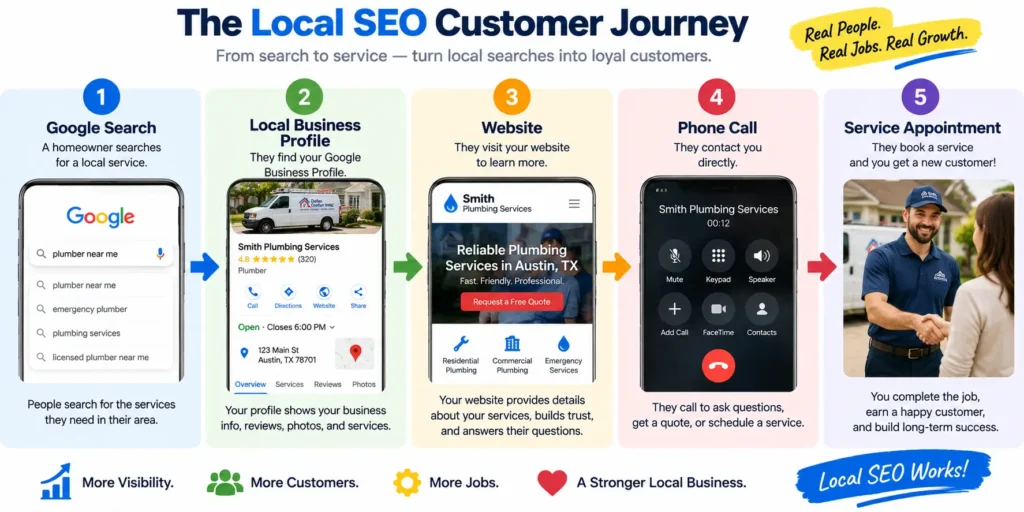
A homeowner in Dallas searches for “AC repair near me.” Someone in Phoenix needs an emergency plumber. A family in Tampa wants a roofer after a storm.
They are not looking for a marketing lesson. They need someone they can trust.
That is where local search optimization helps USA home service businesses get found by people searching for help in their area.
What Is Local Search Optimization?
Local search optimization is the process of improving a business’s online presence so it can appear when people search for local products or services.
For a home service business, this often means showing up when someone searches Google for a plumber, HVAC contractor, roofer, electrician, pest control company, or another service nearby.
Think of it as your digital roadside sign.
A good sign tells people:
- What you do
- Where you work
- How to contact you
- Why they should choose you
Your online presence needs to do the same thing.
A Simple Home Service Example
Imagine Mike owns an HVAC company in Dallas, Texas.
His air conditioning repair work is excellent. His customers are happy. But when homeowners search for “AC repair Dallas,” his company is nowhere near the top of the local results.
The problem may not be his service.
People simply cannot find him.
Local search optimization helps close that gap.
Mike can improve his Google Business Profile, create useful service pages, earn genuine reviews, improve his website, build local authority, and make his service area clear.
Now Google has more information about his business.
More importantly, customers have more reasons to trust it.
Quick Answer: How Does Local SEO Work?
Local SEO helps search engines connect a person’s search with the right nearby business.
For USA home service businesses, three ideas are especially important:
- Relevance: Does the business provide the service the person wants?
- Proximity: Is the business close enough to serve the customer?
- Prominence: Does the business appear established and trustworthy?
For example, someone in Phoenix searches for:
“emergency plumber near me”
Google needs to identify plumbers that are relevant to the search and appropriate for the person’s location.
A strong local presence can help the business compete for that customer.
Why Home Services Are a Great Fit for Local SEO
Home services are naturally local.
A plumber in Charlotte usually does not drive across the country for a $150 repair.
An electrician in Atlanta needs customers within a practical service area.
An HVAC company in Dallas wants homeowners who actually live within its service territory.
That makes geographic search intent extremely important.
Key Takeaways
Local search optimization for home services starts with the basics.
Focus on these areas first:
- Create and complete your Google Business Profile.
- Choose the right business category.
- Keep your business information accurate.
- Clearly explain your service areas.
- Build dedicated service pages.
- Create useful location pages.
- Earn genuine customer reviews.
- Build relevant local citations.
- Earn legitimate local links.
- Make your website mobile-friendly.
- Add appropriate structured data.
- Create content that answers local customer questions.
- Track calls, leads, bookings, and revenue.
You do not need to do everything on day one.
Start with the parts that affect how customers find and contact you.
Local Search Optimization at a Glance
Here is what a strong local SEO plan looks like for a typical USA home service company.
| Area | Example | Main Goal |
|---|---|---|
| Google Business Profile | Dallas HVAC company | Improve local visibility |
| Service pages | AC Repair in Dallas | Match service searches |
| Location pages | HVAC Services in Plano | Explain service areas |
| Reviews | Homeowner feedback | Build trust |
| Citations | Local directories | Reinforce business information |
| Local links | Chamber or community website | Build authority |
| Local content | “How often should you service an AC?” | Answer customer questions |
| Schema | LocalBusiness markup | Help search engines understand data |
| Conversion | Call or quote button | Turn visitors into leads |
Why Local Search Optimization Matters for Home Services
Home service searches are often connected to real problems.
A homeowner does not usually search for a plumber because they are bored.
They may have a leaking pipe.
Someone searching for “garage door repair near me” may have a garage door that will not open.
A person searching for “roof repair Tampa” may have water coming through the ceiling.
These searches can have strong commercial intent.
Think About the Homeowner’s Moment
Imagine a homeowner in Phoenix.
It is 110°F outside.
The air conditioner stops working.
They search:
“AC repair near me”
They are not likely to spend an hour comparing marketing agencies.
They want:
- A nearby HVAC company
- A phone number
- Good reviews
- Available service
- Clear pricing information when available
- Confidence that the company knows what it is doing
A local SEO strategy should help them find those answers quickly.
Local SEO Helps Small Contractors Compete
A small roofing company does not need to beat a national brand for every roofing keyword in America.
It needs to become visible when homeowners in its service area need roofing work.
That is a much more realistic goal.
A family-owned roofing company in Tampa can focus on searches from homeowners in Tampa and nearby communities.
A local electrician in Atlanta can focus on customers within its actual service area.
This is one reason local search optimization can be so valuable for small home service companies.
How Local Search Works
Local search is not simply about putting a city name on every page.
Search engines look at many signals to understand whether a business is a good local match.
Relevance
Relevance means the business matches what the customer searched for.
If someone searches for:
“water heater repair”
a plumbing company that clearly offers water heater repair is more relevant than a company that only advertises drain cleaning.
Your website and business profile should clearly explain your services.
Do not make customers guess.
Proximity
Proximity is about location.
A customer searching for “electrician near me” usually wants someone who can reach their home.
For example, an electrician in Atlanta may serve:
- Atlanta
- Decatur
- Sandy Springs
- Brookhaven
- Nearby communities
The business should clearly state the areas it actually serves.
Do not claim locations simply because you want to rank there.
Prominence
Prominence is about how established and well-known a business appears.
Signals can include:
- Customer reviews
- Local mentions
- Relevant backlinks
- Business directories
- Website authority
- Brand recognition
- Online reputation
Think about it like choosing a contractor through a friend’s recommendation.
If five people in your neighborhood recommend the same roofer, you are more likely to consider that roofer.
Online signals can help create a similar sense of credibility.
Step-by-Step Local Search Optimization Strategy
A home service company does not need a complicated plan.
Start with the foundation and build from there.
Step 1: Create and Optimize Your Google Business Profile
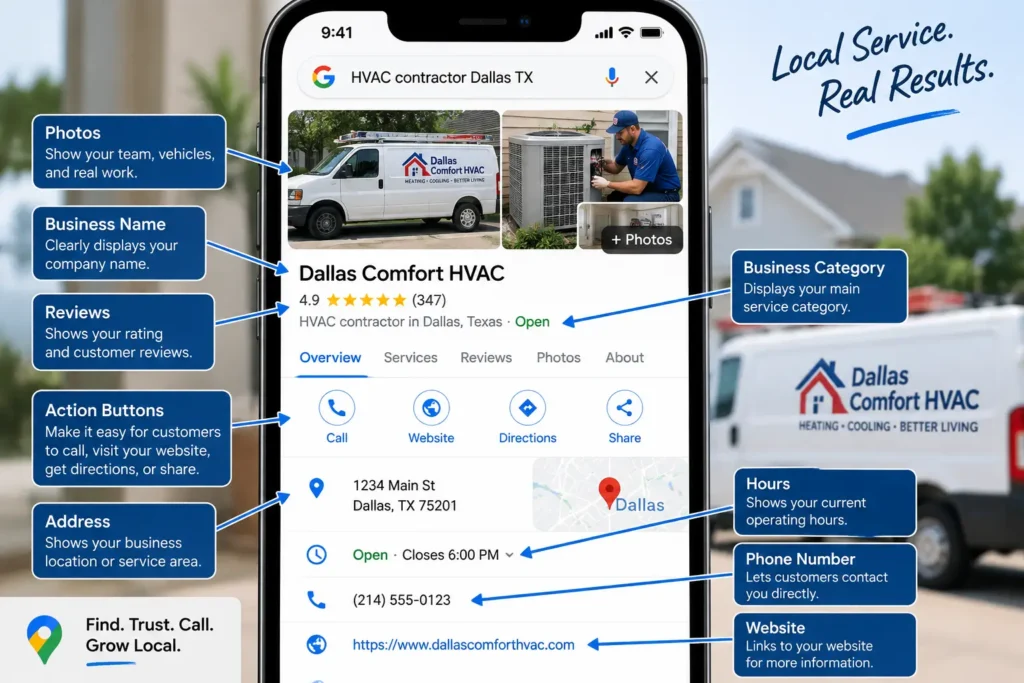
Your Google Business Profile is one of the most important pieces of a local SEO strategy.
You can manage a profile through Google Business Profile.
Make sure the profile contains accurate information.
Check your:
- Business name
- Primary category
- Additional categories
- Address
- Service area
- Phone number
- Website
- Hours
- Holiday hours
- Services
- Photos
- Business description
For a home service business, the service area deserves special attention.
If your HVAC company serves Dallas, Plano, Garland, and Richardson, make sure your public information accurately represents where you work.
Example: Dallas HVAC Company
Suppose Mike runs a company called Dallas Comfort HVAC.
His profile should clearly explain the services he actually provides.
For example:
- AC repair
- AC installation
- HVAC maintenance
- Furnace repair
- Emergency HVAC service
The profile should not claim services the company does not provide.
Step 2: Choose the Correct Business Category
Your primary business category tells Google what your company mainly does.
A roofing contractor should not select an unrelated category simply because it sounds popular.
The same applies to:
- Plumbers
- Electricians
- HVAC contractors
- Pest control companies
- Garage door companies
- Landscapers
- Cleaning companies
Choose the category that best represents the actual business.
Step 3: Build Service Pages
One common mistake is putting every service on one giant page.
A better approach can be to create useful pages for important services.
For an HVAC company, that might include:
- AC repair
- AC installation
- HVAC maintenance
- Furnace repair
- Heat pump service
For a plumbing company:
- Emergency plumbing
- Drain cleaning
- Water heater repair
- Sewer line repair
- Leak detection
For a roofing company:
- Roof repair
- Roof replacement
- Storm damage repair
- Shingle roofing
- Roof inspections
Each page should answer the customer’s questions.
Step 4: Make Location Clear
A customer should know where you work within seconds.
For example:
“We provide residential HVAC repair and installation throughout Dallas and nearby communities.”
That is much clearer than:
“We provide high-quality heating and cooling solutions.”
The second sentence sounds professional.
But it does not tell the homeowner where the company works.
Step 5: Create Useful Location Pages
Location pages can help businesses that genuinely serve several cities or communities.
Imagine a plumbing company based in Charlotte, North Carolina.
It may have pages for:
- Plumbing in Charlotte
- Plumbing in Matthews
- Plumbing in Pineville
- Plumbing in Huntersville
But each page should be useful.
Do not copy one page four times and change the city name.
What Should a Location Page Include?
A useful location page could explain:
- Services available there
- Neighborhoods served
- Common local customer needs
- Service availability
- Local testimonials
- Emergency service information
- FAQs
- Contact information
- Directions when appropriate
The goal is to answer:
“Can this company actually help me at my home?”
Local Keyword Research for Home Services
Keyword research starts with customer problems.
Think about what a homeowner types when something goes wrong.
Common Home Service Searches
People may search for:
- plumber near me
- emergency plumber Phoenix
- AC repair Dallas
- HVAC contractor near me
- roof repair Tampa
- electrician Atlanta
- pest control Orlando
- garage door repair Denver
- landscaper Austin
- water damage restoration Houston
These searches show both service intent and location intent.
Service + City Keywords
One of the simplest patterns is:
Service + city
Examples:
- AC repair Dallas
- plumber Phoenix
- roofer Tampa
- electrician Atlanta
- pest control Orlando
These can be useful targets for service and location pages.
“Near Me” Searches
Another common pattern is:
Service + near me
Examples:
- plumber near me
- electrician near me
- HVAC repair near me
- garage door repair near me
You do not need to repeat “near me” throughout your website.
Google can use geographic information to understand local intent.
Instead, make your location, services, and contact information clear.
USA Home Service Examples
Real examples make local SEO easier to understand.
Here are several ways different home service businesses can approach it.
Example 1: Plumber in Phoenix
Imagine a plumbing company in Phoenix.
A homeowner discovers a burst pipe at 7 a.m.
They search:
“emergency plumber near me”
The plumbing company should make it easy to find:
- Emergency plumbing services
- Service area
- Phone number
- Operating hours
- Customer reviews
- Request-service option
A useful content page might be:
What to Do When a Pipe Bursts in Your Phoenix Home
That article can provide immediate safety advice and then explain when professional plumbing help is needed.
Example 2: HVAC Company in Dallas
Dallas summers can create strong demand for air conditioning services.
A homeowner whose AC stops working may search:
“AC repair Dallas”
The HVAC company could have a dedicated service page titled:
AC Repair in Dallas, TX
The page could explain:
- Common AC problems
- Repair services
- Emergency options
- Maintenance
- Service areas
- Appointment process
- Customer reviews
The company could also publish:
How Often Should You Service Your AC in Dallas?
Now the business is helping customers before they even need a repair.
Example 3: Roofer in Tampa
After a major storm, homeowners may start searching for roofers.
They may type:
“roof repair near me”
or:
“storm damage roof repair Tampa”
A roofing company can prepare useful information about:
- Roof leaks
- Storm damage
- Missing shingles
- Temporary protection
- Roof inspections
- Repair options
- Insurance-related questions
The content should be helpful rather than turning every paragraph into a sales pitch.
Example 4: Electrician in Atlanta
Suppose an Atlanta electrician specializes in residential electrical work.
The company could create pages for:
- Electrical repair
- Panel upgrades
- Outlet installation
- Lighting
- EV charger installation
- Emergency electrical service
A location page could explain the communities served around Atlanta.
This gives customers a clear answer to a simple question:
“Do you come to my area?”
Example 5: Pest Control in Orlando
A pest control company in Orlando could create useful content about common homeowner concerns.
For example:
How to Keep Ants Out of Your Orlando Home
Other topics might include:
- Termite warning signs
- Mosquito prevention
- Rodent problems
- Bed bug treatment
- Seasonal pest issues
This content can attract people before they are ready to hire someone.
Reviews and Reputation Management
Reviews are often one of the first things homeowners look at before hiring a contractor.
Think about your own behavior.
If you need a roofer, would you rather call a company with almost no customer feedback or one with many recent, genuine reviews?
Most people want proof that others had a good experience.
How Should Home Service Companies Get Reviews?
Ask real customers after completing a job.
For example, after replacing an AC unit, the company could send a simple follow-up message asking the customer to share an honest review.
Keep it easy.
Do not offer fake incentives for positive reviews.
Do not buy reviews.
Do not create fake customer accounts.
What Makes a Review Useful?
A detailed review can tell future customers what actually happened.
For example:
“Our AC stopped working on a Sunday afternoon. The technician arrived that evening, found the problem, and explained the repair before starting.”
That tells a future customer much more than:
“Great company.”
Never write reviews for customers.
Let customers speak in their own words.
Local Citations for Home Services
A citation is a mention of your business information on another website.
This can include your:
- Business name
- Address
- Phone number
- Website
For USA home service businesses, relevant sources may include:
- Industry directories
- Local business directories
- Trade organizations
- Chambers of commerce
- Community organizations
- Local publications
Should You Submit to Hundreds of Directories?
No.
More is not automatically better.
Focus on reputable and relevant websites.
A legitimate local chamber of commerce listing can make more sense than dozens of low-quality directories nobody uses.
Keep your information accurate.
Build Local Links
Local links can help show that your business is part of a real community.
Imagine a landscaping company in Austin sponsors a neighborhood gardening event.
The event organizer publishes a page listing sponsors and links to the company’s website.
That link has context.
It exists because of a real relationship.
Other opportunities may include:
- Local newspapers
- Community organizations
- Trade groups
- Local events
- Neighborhood associations
- Business organizations
- Relevant local blogs
The best local links are usually earned through real activity.
Create Local Content That Helps Homeowners
A home service website should answer questions homeowners actually have.
Do not write articles just because you found a keyword.
Start with a real problem.
Plumbing Content Ideas
- How to shut off your home’s main water supply
- Signs you may have a hidden water leak
- When should you replace a water heater?
- What causes low water pressure?
- What to do before a plumber arrives
HVAC Content Ideas
- How often should you service an AC?
- Why is my AC blowing warm air?
- How can homeowners reduce cooling costs?
- When should an HVAC system be replaced?
- What does an HVAC maintenance visit include?
Roofing Content Ideas
- Signs your roof may need repair
- What to check after a storm
- How long do asphalt shingles last?
- Roof repair vs. replacement
- How to choose a roofing contractor
Electrical Content Ideas
- Signs of an electrical problem
- When should an electrical panel be replaced?
- Why are outlets getting warm?
- What should homeowners know about EV charger installation?
These topics are useful even before a customer is ready to hire you.
Optimize for Voice Search and Questions
People often search using complete questions.
A homeowner might ask:
“Who can fix my AC near me?”
Or:
“How much does roof repair cost in Tampa?”
Or:
“What should I do if my water heater is leaking?”
Your website should answer these questions directly.
Use Natural Questions
For example:
How quickly can an emergency plumber arrive?
Response:
Response times depend on location, traffic, technician availability, and the type of emergency. Call the company to check current availability.
That is better than making a promise you cannot guarantee.
LocalBusiness Schema Markup
Structured data helps search engines understand important information about a business.
For a home service company, relevant Schema.org types may include:
- LocalBusiness
- Plumber
- Electrician
- RoofingContractor
- HVACBusiness
- HomeAndConstructionBusiness
- ProfessionalService
Use the most appropriate type available for the business.
You can learn about search structured data from Google Search Central and business markup from Schema.org.
What Can You Include?
Depending on the business and markup, information may include:
- Business name
- Address
- Phone number
- Website
- Hours
- Service area
- Geographic coordinates
- Relevant social profiles
Only provide information that is accurate.
Do not use schema as a place to add claims that customers cannot see or verify.
Local Search Optimization Checklist
A checklist can make local SEO much easier.
Work through it one section at a time.
Google Business Profile Checklist
- Profile claimed
- Profile verified
- Correct business name
- Correct primary category
- Relevant additional categories
- Accurate address
- Accurate service area
- Correct phone number
- Website added
- Current business hours
- Holiday hours updated
- Services listed
- Photos added
- Reviews monitored
- Reviews answered
- Customer questions monitored
Website Checklist
- Services are clearly explained
- Service areas are easy to find
- Phone number is visible
- Contact information is accurate
- Website works on mobile
- Pages load quickly
- Calls to action are clear
- Important service pages exist
- Useful location pages exist
- FAQs answer real customer questions
- Structured data is appropriate
- Thin or duplicate pages are improved
Reputation Checklist
- Real customers are asked for feedback
- Reviews are monitored
- Positive reviews receive responses
- Complaints receive professional responses
- Fake reviews are never purchased
- Employees do not pose as customers
Local Authority Checklist
- Relevant directories
- Trade organizations
- Local business associations
- Community mentions
- Local partnerships
- Relevant local backlinks
Common Local SEO Mistakes
Most mistakes come from trying to do too much instead of doing the basics well.
Mistake 1: Stuffing City Names Everywhere
Writing “Dallas HVAC” in every sentence does not make content better.
It makes the page uncomfortable to read.
Use location terms where they make sense.
Mistake 2: Creating Fake Service Locations
Suppose a plumber works in Phoenix.
That does not mean the company should create fake offices in Tucson, Las Vegas, and Los Angeles.
Only represent locations the business genuinely serves.
Mistake 3: Creating Dozens of Duplicate Pages
A company creates:
- Plumber Dallas
- Plumber Plano
- Plumber Garland
- Plumber Frisco
Then copies the same paragraph onto every page.
That does not give customers much value.
Each page should have a real reason to exist.
Mistake 4: Ignoring Reviews
A business may have an excellent website but poor online reputation management.
If customers leave questions and complaints and nobody responds, potential customers notice.
Mistake 5: Using the Wrong Business Category
A business category should describe the actual business.
Do not select unrelated categories simply because they sound attractive.
Mistake 6: Forgetting Mobile Users
A homeowner searching for a plumber is often using a phone.
If the phone number is difficult to tap, the contact form is broken, or the website is hard to read, the customer may leave.
Mistake 7: Measuring Only Rankings
Ranking is not the final goal.
Suppose a roofing company moves from position nine to position five.
That sounds good.
But if calls and quote requests stay flat, something else may need attention.
Track business results.
Local SEO vs. Traditional SEO
Traditional SEO and local SEO share many fundamentals.
The main difference is the role of location.
| Factor | Traditional SEO | Local SEO |
|---|---|---|
| Main audience | Broad audience | Local customers |
| Main goal | Organic visibility | Local visibility and leads |
| Search | Search engines | Search and Maps |
| Geography | May be secondary | Central |
| Business Profile | Usually less important | Very important |
| Reviews | Helpful | Especially important |
| Citations | Sometimes useful | Often useful |
| Local links | Helpful | Valuable |
| Search intent | Informational/commercial | Often highly commercial |
A home service company needs both.
Technical SEO helps search engines crawl and understand the website.
Content helps answer customer questions.
Local SEO connects the business with its geographic market.
Pros and Cons of Local Search Optimization
Local SEO can be powerful, but it is not a magic switch.
It takes consistent work.
Pros
- Reaches customers in your service area
- Can attract high-intent searches
- Helps businesses appear in local search results
- Supports Maps visibility
- Builds trust through reviews
- Can generate calls and quote requests
- Helps smaller contractors compete in specific markets
Cons
- Results are not instant
- Competition varies by city
- Some home service markets are very competitive
- Reviews require ongoing management
- Rankings can change
- Poor customer service can damage online reputation
- Fake or manipulative tactics can create problems
How Long Does Local SEO Take?
There is no universal timeline.
A new plumber in a small town may face less competition than an established HVAC company in Dallas.
Several factors can affect progress:
- Competition
- Business history
- Website quality
- Reviews
- Location
- Service area
- Local authority
- Technical SEO
- Search demand
- Existing online presence
Be cautious if an agency promises:
“We guarantee number one in Google in 30 days.”
No legitimate SEO strategy can guarantee a specific ranking for every local search.
A better question is:
Are we becoming more visible and generating more qualified customers?
How to Measure Local SEO Success
The most useful local SEO report connects search activity to business results.
Track:
- Local search visibility
- Google Business Profile interactions
- Website traffic
- Service-page traffic
- Phone calls
- Quote requests
- Contact form submissions
- Appointment bookings
- Conversion rate
- Revenue
Example: HVAC Company
Imagine Mike’s Dallas HVAC company receives:
- 300 local website visits
- 40 phone calls
- 20 quote requests
- 12 new customers
Those numbers tell Mike more than simply knowing that his website ranks for “Dallas HVAC.”
The ranking is useful.
The customers are the point.
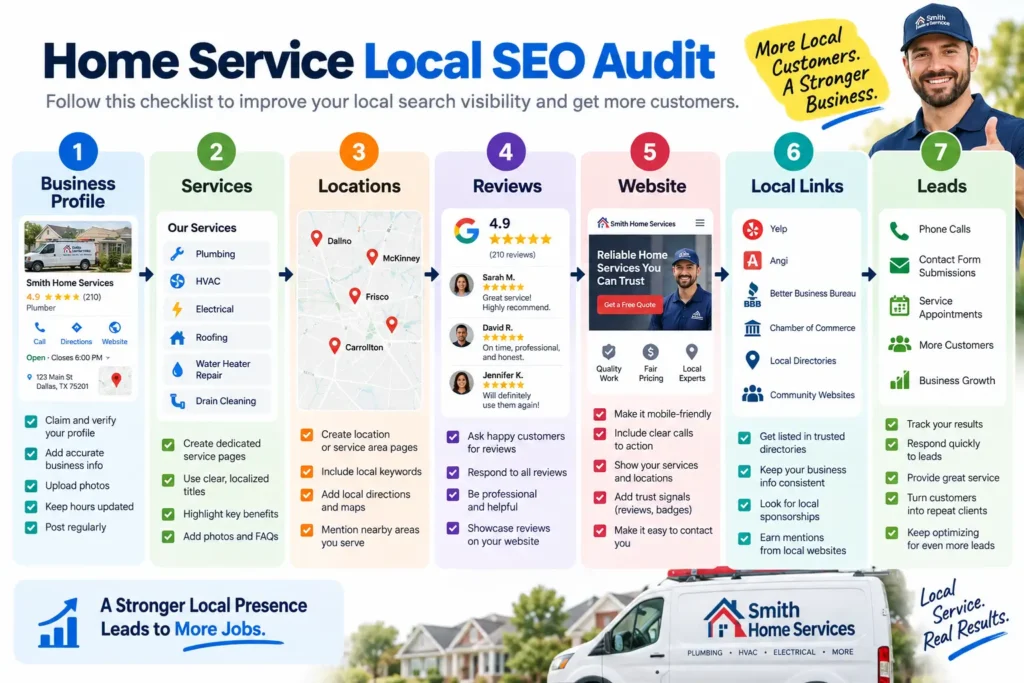
A Simple Local SEO Audit for Home Services
You can perform a basic audit in one afternoon.
Start with the customer’s experience.
Step 1: Search the Business Name
Search the company name on Google.
Check:
- Business information
- Hours
- Phone number
- Website
- Reviews
- Photos
Is everything correct?
Step 2: Search the Main Service
Search:
“[service] + [city]”
For example:
“AC repair Dallas”
or:
“roof repair Tampa”
Look at the businesses appearing in local results.
Step 3: Compare Competitors
Study the strongest competitors.
Ask:
- How complete are their profiles?
- How many reviews do they have?
- What services do they list?
- Is their website easy to use?
- Do they have strong service pages?
- Do they have local mentions?
- Do they make it easy to request a quote?
Do not copy them.
Look for gaps you can improve.
Step 4: Check the Website
Open the homepage.
Within a few seconds, can you tell:
- What does this company do?
- Where does it work?
- How can I contact it?
- Why should I trust it?
If not, improve the page.
Step 5: Test the Website on a Phone
Pretend you are a homeowner.
Can you:
- Tap the phone number?
- Request a quote?
- Find the service area?
- Read the text?
- Find the hours?
- Navigate without frustration?
If not, fix the experience.
Step 6: Check Reviews
Read both good and bad reviews.
Look for repeated themes.
Customers may repeatedly praise:
- Fast response
- Friendly technicians
- Clear pricing
- Quality workmanship
Those strengths can help you understand what the business does well.
Repeated complaints can show what needs fixing.
Step 7: Check Local Mentions
Search the company name and city.
Look for:
- Directories
- Local news
- Trade organizations
- Community websites
- Local partnerships
Make sure important business information is accurate.
Step 8: Check Conversions
Finally, ask:
“Are people actually contacting us?”
Track calls, forms, bookings, quote requests, and sales.
That is where SEO becomes connected to revenue.
Expert Tips for Home Service Businesses
The strongest local SEO strategies usually start with customer needs.
You do not need complicated tricks.
Be Specific About Your Services
“Home services” is broad.
“Water heater repair and replacement” is specific.
Specific service pages can help customers understand exactly what you do.
Be Honest About Your Service Area
Do not advertise a city if you do not actually serve it.
A customer who clicks through and discovers you do not work in their area has wasted time.
Show Your Work
Homeowners want to know what they are hiring someone to do.
Where appropriate, show:
- Completed projects
- Before-and-after photos
- Equipment
- Technicians
- Work processes
- Certifications or licenses
- Customer testimonials
Real information builds trust.
Make Calling Easy
For many home service businesses, the phone is still a major conversion channel.
Put the phone number somewhere customers can easily find it.
On mobile, make it easy to tap.
Answer the Questions Homeowners Ask
Your technicians hear customer questions every day.
Turn those questions into website content.
If customers constantly ask:
“How do I know if my AC needs to be replaced?”
write an article answering that question.
If homeowners ask:
“Can a small roof leak wait?”
answer it clearly.
Your best content ideas may already be sitting in your customer service inbox.
Home Service Local SEO Content Ideas
Different industries have different local questions.
Here are examples you can adapt.
Plumbing
Main service pages:
- Emergency Plumber
- Drain Cleaning
- Water Heater Repair
- Sewer Repair
- Leak Detection
Content ideas:
- What to do when a pipe bursts
- Signs of a hidden water leak
- When to replace a water heater
- Why does my drain keep clogging?
HVAC
Main service pages:
- AC Repair
- AC Installation
- HVAC Maintenance
- Furnace Repair
- Heat Pump Repair
Content ideas:
- Why is my AC blowing warm air?
- How often should I service my HVAC system?
- Should I repair or replace my AC?
- How can I improve indoor comfort?
Roofing
Main service pages:
- Roof Repair
- Roof Replacement
- Storm Damage Repair
- Roof Inspection
- Shingle Roofing
Content ideas:
- What to inspect after a storm
- Signs your roof needs repair
- How long do shingles last?
- Roof repair vs. replacement
Electrical
Main service pages:
- Electrical Repair
- Panel Upgrades
- Outlet Installation
- Lighting
- EV Charger Installation
Content ideas:
- Why are my outlets warm?
- When should an electrical panel be replaced?
- What causes circuit breakers to trip?
- What should homeowners know about EV chargers?
Frequently Asked Questions
What Is Local Search Optimization for Home Services?
Local search optimization helps plumbers, HVAC companies, roofers, electricians, pest control companies, and other contractors become easier to find when homeowners search for services in their area.
Is Local SEO Worth It for a Small Contractor?
Yes. Local SEO can be especially useful for small contractors because they can focus on customers within a practical service area instead of competing for searches across the entire country.
Can a Service-Area Business Rank Without a Storefront?
Yes. A service-area business can have a local online presence without operating a customer-facing storefront. Its service area and business information should accurately reflect where it operates.
Should a Plumber Create a Page for Every City?
Not necessarily. Create a city page when it provides useful information for customers in that area. Avoid making dozens of nearly identical pages that only change the city name.
Why Do Reviews Matter for Home Service Companies?
Reviews help potential customers judge a contractor before making contact. They can show experience, reliability, communication, and customer satisfaction.
When Should a Home Service Business Start Local SEO?
The sooner the better. Setting up accurate business information, building a useful website, earning genuine reviews, and creating local authority takes time.
Local SEO Helps Home Service Businesses Get Found
When a homeowner needs a plumber, roofer, HVAC technician, or electrician, they usually search for help nearby. They want a business they can find quickly and trust.
That is why local search optimization matters for USA home service businesses.
Start with the basics. Keep your Google Business Profile accurate. Make your services and service areas clear. Build helpful location pages, earn genuine customer reviews, and create content that answers real homeowner questions.
Do not focus only on rankings. Look at the bigger picture. Are more people calling? Are quote requests increasing? Are you booking more jobs?
Good local SEO connects your business with people who already need your services. When your online presence matches the quality of your real-world work, search visibility can turn into calls, appointments, and new customers.
Recommended Sources
- Google Business Profile
- Google Search Central
- Google Search Central: Local Business Structured Data
- Schema.org LocalBusiness