If you run a local home-service business, local SEO ranking factors can decide whether customers find you first or call the company down the street.
For a plumber in Houston or an AC repair company in Dubai, showing up in Google Maps can mean the difference between a busy day and an empty schedule.
What Are Local SEO Ranking Factors?
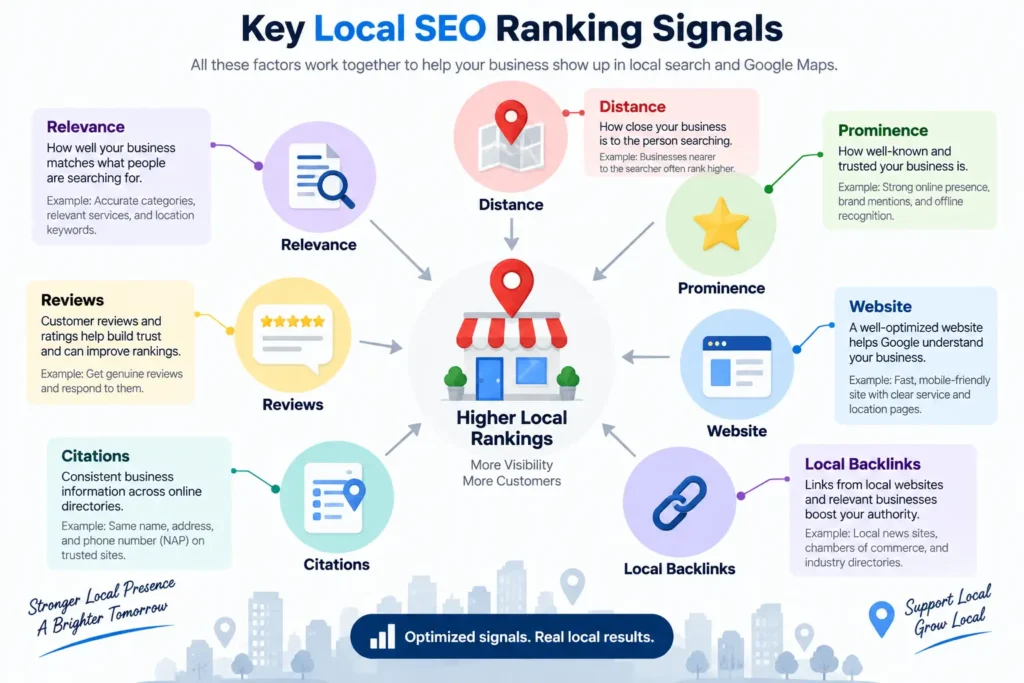
Local SEO ranking factors are the signals Google uses to decide which local businesses should appear for a search. The main factors Google publicly identifies are relevance, distance, and prominence.
Think of Google like a helpful receptionist. A customer says, “I need an emergency plumber near me.” Google looks for a business that offers plumbing, is close enough to serve the customer, and has enough signals to show that the business is established and trustworthy.
Quick Answer
The most important local SEO ranking factors include:
- Google Business Profile completeness and accuracy
- Business category and service relevance
- Distance from the searcher
- Reviews, ratings, and review quality
- Local prominence and brand recognition
- Local citations and consistent business information
- Relevant backlinks and local mentions
- Website quality and local on-page SEO
- Location and service-area information
- Helpful service and location pages
- Mobile usability and page experience
- Real business photos and supporting content
Google says local results are mainly based on relevance, distance, and prominence.
Key Takeaways
The biggest lesson is simple: you cannot optimize one local SEO factor and expect to dominate every search.
A strong local presence usually comes from many signals working together.
For example, a Dallas HVAC company may have 500 reviews. But if its Google Business Profile says little about the services it provides, its website is weak, and its business information is inconsistent, it may struggle to compete for specific searches.
On the other hand, a smaller HVAC company with a well-built profile, strong service pages, genuine reviews, local links, and clear information can compete much more effectively.
How Google Determines Local Rankings
Google does not publish a secret checklist with a fixed number of ranking points. Instead, it explains local rankings through three broad ideas: relevance, distance, and prominence.
1. Relevance
Relevance means how closely your business matches what the customer is looking for.
If someone searches for “water heater repair Phoenix,” Google needs to understand whether your company actually provides water heater repair in that market.
A plumbing company that clearly lists water heater repair, emergency plumbing, drain cleaning, and other services gives Google more useful information than a profile that simply says “plumber.”
Example: A plumber in Phoenix should clearly explain its plumbing services on its website and Business Profile rather than trying to rank for every home service imaginable.
2. Distance
Distance is exactly what it sounds like. Google considers how far a business is from the person searching or from the location used in the search.
This is why a search for “AC repair near me” can produce different results for two people standing a few miles apart.
A Dubai AC repair company cannot simply write “Dubai” hundreds of times and expect to rank equally across the entire emirate.
Proximity still matters.
3. Prominence
Prominence describes how well-known or established a business appears to be.
Google says prominence can be influenced by information such as links from other websites and reviews.
For a home-service business, this can include genuine customer reviews, local mentions, relevant backlinks, citations, and the overall strength of the company’s online presence.
Think of it like reputation in a neighborhood.
If 200 people know a reliable plumber and 20 people know another plumber, the first company has stronger real-world recognition.
12 Important Local SEO Ranking Factors
The three Google categories are the foundation. The following signals help explain how a local business can strengthen those areas.
1. Google Business Profile
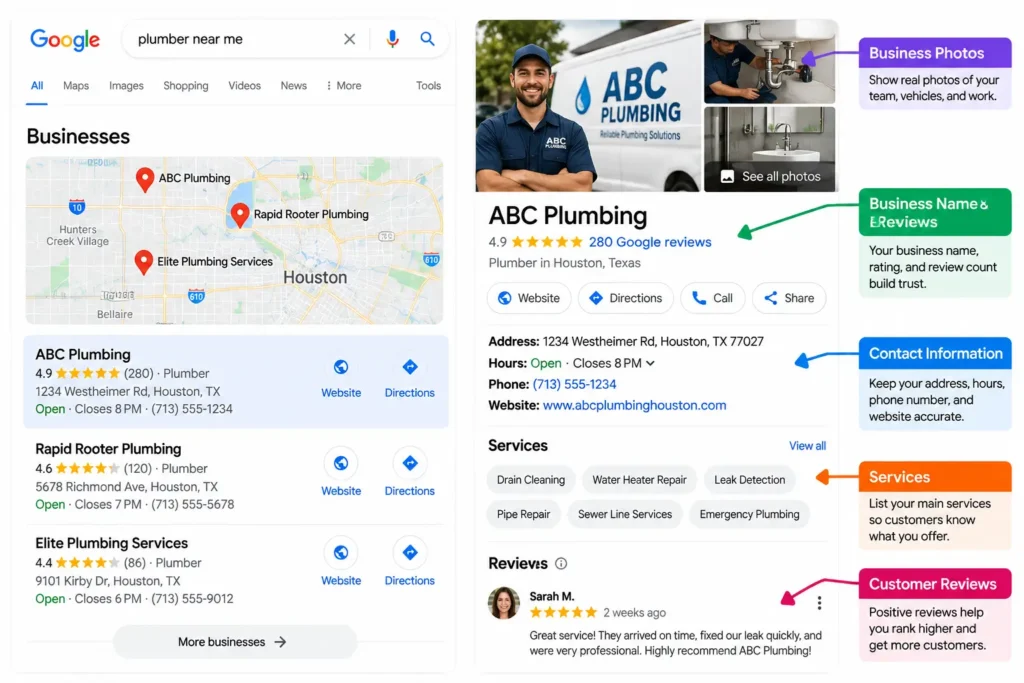
Your Google Business Profile is one of the most important assets in local SEO.
It can appear in Google Search and Google Maps and gives customers information such as your business name, category, hours, phone number, website, photos, and reviews.
Google recommends keeping Business Profile information complete and accurate.
What to optimize
Check that your profile has:
- Correct business name
- Correct primary category
- Relevant secondary categories where appropriate
- Accurate phone number
- Correct website
- Business hours
- Holiday and special hours
- Services
- Business description
- Service areas where applicable
- High-quality photos
- Genuine customer reviews
- Accurate location information
Do not treat the profile like a one-time setup.
Your business changes. Your profile should stay accurate too.
2. Primary Business Category
Your primary category tells Google what your business mainly does.
Choosing the closest accurate category can help Google understand the intent your business should match.
For example, a company primarily providing residential plumbing should not select an unrelated category simply because it sounds popular.
Think of the category as the label on a toolbox.
If the label says “Plumber,” Google has a clear idea of what is inside. If the information is vague, matching becomes harder.
3. Services Listed on Your Profile
Your services help explain what you actually do.
A home-service company should make its core services easy to understand.
For a USA HVAC company, this might include:
- AC repair
- AC installation
- Furnace repair
- Heat pump installation
- HVAC maintenance
- Emergency HVAC service
For a UAE company, it could include:
- Split AC repair
- Central AC maintenance
- AC installation
- Duct cleaning
- Chiller services
- Emergency AC repair
Do not add services you do not actually provide.
Accuracy matters more than having a huge list.
4. Customer Reviews and Ratings
Reviews are important for both trust and local visibility.
Google says reviews and positive ratings can help a business’s local ranking.
Reviews also affect whether a customer chooses to call you.
Imagine two roofers:
Roofer A: 4.9 stars from 280 reviews
Roofer B: 4.2 stars from 18 reviews
Even before visiting either website, many customers will feel more comfortable contacting Roofer A.
But do not buy reviews.
Google says businesses should ask for genuine reviews and prohibits incentives in exchange for reviews, changes, or removal of negative reviews.
Better review strategy
After completing a job:
- Finish the work properly.
- Ask the customer for honest feedback.
- Send a direct Google review link.
- Make the request easy.
- Respond professionally to the review.
- Never offer money or discounts for positive reviews.
A simple message can work:
“Thanks for choosing us for your AC repair. If you have a minute, we’d appreciate an honest Google review about your experience.”
5. Review Responses
Getting reviews is only part of the job.
Responding to reviews shows customers that you pay attention.
Google specifically recommends responding to reviews.
For example:
“Thank you, Sarah. We’re glad we could repair your water heater quickly.”
A negative review deserves a calm response too.
Do not argue publicly. Do not reveal private customer information. Offer to continue the conversation privately when appropriate.
6. NAP Consistency
NAP means:
- Name
- Address
- Phone number
Your basic business information should be consistent across important online sources.
For example, if your website says:
ABC Plumbing LLC
123 Main Street
Houston, TX
(713) 555-1234
but a directory lists a different phone number or old address, search engines may have to reconcile conflicting information.
Google says it gathers local business information from many sources, including websites, third-party data, users, business owners, and its own interactions with places.
Consistency makes that information easier to understand.
7. Local Citations
A local citation is a mention of your business’s key information on another website.
Common examples include:
- Business directories
- Local chambers of commerce
- Industry directories
- Local news websites
- Professional associations
- Community websites
A citation does not have to be complicated.
For a Miami electrician, a listing on a trusted local business directory can reinforce the connection between the business and its service area.
For a Dubai pest control company, relevant UAE business directories and local industry sites may provide useful local references.
Quality matters more than collecting hundreds of random directory listings.
8. Local Backlinks
A backlink is a link from another website to your website.
Relevant local links can strengthen your online presence.
For example, a San Antonio roofing company might earn a link from:
- A local business association
- A neighborhood publication
- A home improvement organization
- A local charity
- A construction industry website
A Dubai landscaping company might be mentioned by a local property publication or a UAE construction organization.
The goal is not to collect links from every website you can find.
The goal is to earn links that make sense.
9. Localized Website Content
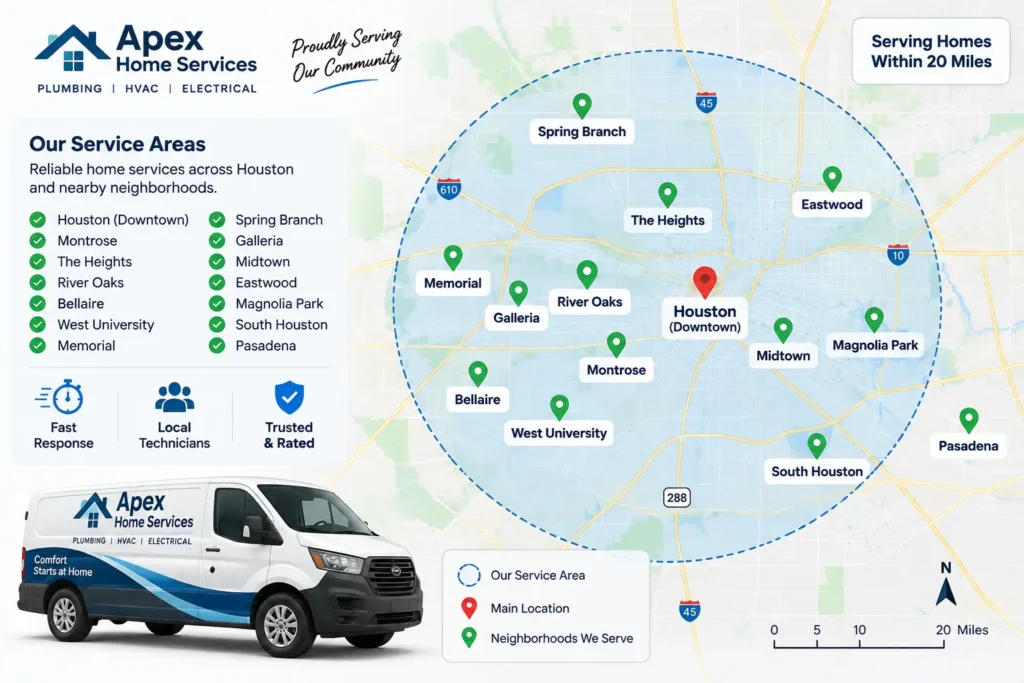
Your website needs to make your location and services clear.
A plumber serving Austin should have useful information about plumbing services in Austin.
A home-service company serving multiple cities can create genuinely useful location pages when those locations are real service areas.
A strong local service page might explain:
- What service you provide
- Which areas you serve
- Common customer problems
- Pricing factors
- How the service works
- Emergency availability
- What customers should expect
- How to contact you
Avoid creating dozens of pages that simply replace the city name.
For example:
“Plumber in Dallas”
“Plumber in Houston”
“Plumber in Austin”
If every page contains the same text with only the city changed, the pages offer little additional value.
10. On-Page Local SEO
On-page SEO helps Google understand each page.
For a local service page, consider:
- Page title
- H1 heading
- Service name
- Location
- Helpful headings
- Internal links
- Contact information
- Service details
- Relevant images
- Clear calls to action
For example:
H1: Emergency AC Repair in Dubai
Then explain the actual service.
Do not turn the page into a pile of keywords.
Write for the homeowner who needs help.
11. Business Website Quality
Your Google Business Profile and website should support each other.
Google can use publicly available information from websites when compiling local listings.
Your website should clearly communicate:
- Who you are
- What you do
- Where you operate
- How customers can contact you
- What services you provide
- Why customers should trust you
A plumber does not need a fancy website.
It needs a useful one.
If a homeowner lands on the page at 10 p.m. because a pipe burst, they should quickly find the phone number, service area, emergency information, and next step.
12. Photos and Real Business Content
Photos give customers another way to understand your business.
Google recommends adding photos and videos to Business Profiles.
For home services, useful photos might include:
- Team members
- Service vehicles
- Completed projects
- Equipment
- Before-and-after work
- Office or storefront
- Technicians working
- Branded uniforms
A real photo of your technician repairing an AC unit is more useful than a generic stock photo of a smiling person holding a wrench.
Local SEO for USA Home Services
Home-service businesses in the USA face intense local competition.
A customer might search “emergency plumber near me” and see several companies within seconds.
Example: Houston Plumber
Imagine a Houston plumbing company called ABC Plumbing.
Its local SEO plan could include:
- Verified Google Business Profile
- Accurate plumber category
- Emergency plumbing service listed
- Water heater repair service
- Drain cleaning service
- Houston service-area information
- Genuine customer reviews
- Local citations
- Links from relevant Houston websites
- Dedicated service pages
- Mobile-friendly website
- Clear phone number
- Real job photos
The company does not need to “hack” Google.
It needs to make it easy for Google and customers to understand the business.
Example: Miami HVAC Company
Suppose a Miami HVAC company wants more calls for AC repair.
Instead of creating one giant page called “HVAC Services,” it could build useful pages for:
- AC repair
- AC installation
- AC maintenance
- Emergency AC service
- Ductless mini-split service
Each page should answer real customer questions.
For example:
“Why is my AC blowing warm air?”
That question can lead naturally into an explanation of common causes and when to call a professional.
Local SEO for UAE Home Services
Local SEO works slightly differently in practice across markets, but the same basic principles apply.
Relevance, distance, and prominence remain central to Google’s local ranking system.
Example: Dubai AC Repair Company
Imagine an AC company serving Dubai.
Its website might clearly identify:
- Dubai service areas
- AC repair
- AC maintenance
- Central AC service
- Split AC repair
- Emergency AC service
- Contact information
- Business hours
The company can also build genuine local visibility through relevant UAE directories, local publications, industry organizations, and customer reviews.
Example: Abu Dhabi Cleaning Company
A cleaning company in Abu Dhabi might target services such as:
- Deep cleaning
- Move-in cleaning
- Move-out cleaning
- Villa cleaning
- Office cleaning
- Carpet cleaning
The website should explain what each service includes.
Instead of repeating “cleaning company Abu Dhabi” over and over, answer customer questions.
For example:
“How much does a deep cleaning service cost?”
“How long does a villa cleaning take?”
“What is included in move-out cleaning?”
That is useful content.
Local SEO Ranking Factors vs. Common Myths
There is a lot of bad local SEO advice online.
Some tactics sound clever but can create more problems than they solve.
Myth: More Keywords Always Mean Higher Rankings
No.
Adding a city name to every sentence does not automatically improve local rankings.
Google looks at relevance and many other signals.
Write naturally.
Myth: You Can Pay Google for Better Organic Local Rankings
Google says there is no way to request or pay for a better local ranking.
Advertising and organic local visibility are different things.
Myth: More Reviews Always Guarantee the #1 Spot
Reviews matter, but they are not the only factor.
Google’s local ranking system considers relevance, distance, and prominence together.
Myth: You Should Create Fake Locations
Creating fake offices to rank in more cities is risky and can violate Google’s guidelines.
If your company does not have a real location or genuinely serves an area, do not pretend it does.
A Simple Local SEO Checklist
Use this checklist when reviewing a local business.
Google Business Profile Checklist
- Business is verified
- Business name is accurate
- Primary category is correct
- Relevant services are listed
- Phone number is correct
- Website URL is correct
- Hours are accurate
- Special hours are updated
- Service areas are accurate
- Business description is useful
- Real photos have been added
- Reviews are being monitored
- Reviews receive professional responses
Google’s Profile Strength tool can also help verified businesses identify missing information and add content such as photos and videos.
Website Checklist
- Clear service pages
- Clear location information
- Mobile-friendly design
- Fast, usable pages
- Consistent NAP information
- Descriptive page titles
- Useful H1 headings
- Internal links
- Clear contact information
- Real business photos
- Helpful FAQs
- Strong calls to action
Reputation Checklist
- Ask real customers for honest reviews
- Never buy reviews
- Never offer rewards for positive reviews
- Respond to positive reviews
- Respond professionally to negative reviews
- Monitor important review platforms
Google explicitly prohibits incentives for reviews and other forms of rating manipulation.
How to Improve Local SEO Step by Step
You do not need to fix everything on day one.
Start with the basics, then build stronger signals over time.
Step 1: Fix Your Business Profile
Make sure the information is complete, accurate, and current.
Start with the business name, category, phone, website, hours, services, and location details.
Step 2: Improve Your Website
Create useful pages for your most important services.
Make sure each page explains the service clearly and identifies the areas you genuinely serve.
Step 3: Build a Review Process
Do not wait for reviews to happen by accident.
After a successful job, make it easy for the customer to leave honest feedback.
Step 4: Clean Up Business Listings
Look for major directories and industry websites where your company appears.
Fix incorrect names, phone numbers, addresses, and URLs.
Step 5: Earn Local Mentions
Build relationships with local organizations, publications, associations, and businesses.
A useful local mention can be far more valuable than dozens of irrelevant links.
Step 6: Track Performance
Google Business Profile performance data can show searches, views, and customer actions from Search and Maps.
Look for patterns.
Which services bring searches?
Which locations generate calls?
Which pages attract traffic?
Use that information to decide what to improve next.
Advanced Local SEO Tips
Once the basics are working, you can work on deeper signals.
Build Service + Location Relevance
Think about the actual searches customers make.
Instead of targeting only:
“Plumber”
you may need useful content around:
- Emergency plumber
- Water heater repair
- Drain cleaning
- Sewer line repair
- Bathroom plumbing
- Residential plumbing
- Commercial plumbing
Then connect those services to the locations you genuinely serve.
Use LocalBusiness Structured Data
Structured data gives search engines machine-readable information about your business.
Google’s LocalBusiness documentation recommends using the most specific appropriate LocalBusiness subtype and providing details such as name and address.
For example, a business might use an appropriate local business type such as Plumber, Electrician, or another relevant type supported by Schema.org.
Structured data is not a magic ranking button.
Its main job is to help search engines understand the information on a page.
Strengthen Your Entity Signals
Your business should be easy to identify across the web.
Try to keep important details connected:
Business → Service → Location → Website → Reviews → Citations → Local mentions
For example:
ABC HVAC → AC Repair → Miami, Florida → abchvac.com → Google reviews → local directories → Miami business mentions
This creates a clearer picture of the company.
Common Local SEO Mistakes
Small mistakes can make local SEO harder than it needs to be.
Keyword Stuffing
Repeating “best plumber in Houston” 30 times does not make a page better.
Write normally.
Fake Reviews
Fake reviews can damage trust and violate Google’s policies.
Fake Locations
Do not create fake offices just to appear in more places.
Duplicate Location Pages
If ten city pages contain almost identical content, customers gain little value.
Make location pages genuinely useful.
Ignoring Negative Reviews
A negative review is not the end of the world.
A calm, professional response can show future customers how your company handles problems.
Using Only Stock Photos
Stock images can make a local business look generic.
Use real photos whenever possible.
Pros and Cons of Local SEO
Local SEO has major benefits, but it is not instant.
Pros
- Reaches customers with local intent
- Can generate phone calls and leads
- Helps businesses appear in Google Maps
- Builds long-term online visibility
- Supports brand trust
- Helps customers find important business information
Cons
- Results can take time
- Competition varies by city
- Distance can limit visibility
- Reviews require ongoing attention
- Business information needs regular maintenance
- Rankings can change as competitors improve
The goal is not to chase one ranking position forever.
The goal is to build a business that Google can understand and customers can trust.
Frequently Asked Questions
What are the most important local SEO ranking factors?
Google says local rankings are mainly based on relevance, distance, and prominence. Business Profile information, reviews, links, and other online information can help establish these signals.
Is Google Business Profile important for local SEO?
Yes. A complete and accurate Google Business Profile helps Google understand your business and gives customers useful information in Search and Maps.
Can reviews improve local SEO rankings?
Yes. Google states that more reviews and positive ratings can help a business’s local ranking. Reviews must be genuine and should not be bought or incentivized.
Should local businesses build backlinks?
Yes, but focus on relevant, trustworthy links rather than collecting links from random websites. Google says prominence can include information such as links from other websites.
Why does my competitor rank higher than my business?
There may be several reasons. Your competitor could be more relevant to the search, closer to the customer, more prominent, better reviewed, or stronger across its overall online presence.
When should I expect local SEO results?
There is no fixed timeline. Local rankings depend on competition, location, business history, website quality, reviews, and other signals. New Business Profiles can take time to appear in search results.
Final Verdict: Focus on Local SEO Fundamentals
The best local SEO strategy is not a secret trick.
Focus on the fundamentals.
Make your business information accurate. Choose the right category. Explain your services clearly. Build a useful website. Earn genuine reviews. Keep your business information consistent. Build real local relationships and relevant mentions.
Most importantly, remember the three ideas Google gives us: relevance, distance, and prominence.
For a Houston plumber, that means being clearly relevant to plumbing searches in Houston.
For a Dubai AC company, it means clearly communicating its AC services and genuine service areas.
Local SEO works best when the online picture matches the real business.
Be clear. Be useful. Be trustworthy. Then keep improving.
Authoritative Sources
- Google Business Profile: Improve your local ranking on Google
- Google: How local listings information is sourced
- Google Search Central: LocalBusiness structured data
- Google Business Profile: Tips to get more reviews