


Most construction companies don’t struggle because they lack skills. They struggle because customers can’t find them when it matters. Construction SEO solves that problem.
It helps builders and contractors show up locally, earn trust fast, and turn searches into calls.
If you’re new to SEO, understanding what SEO is and how it works will help set the right expectations before diving deeper.
What Is Construction SEO and Why It Works
Construction SEO helps nearby customers find and trust your business when they search for construction services online.
In practice, it means showing up in local results, proving credibility through real projects, and making it easy to call or request a quote. This approach is similar to what works for other trades like roofing and plumbing, but construction often involves longer decision cycles and higher trust requirements.
When we first worked with a contractor, their website ranked for broad keywords but produced zero calls. Once we applied a local-first SEO approach, calls started coming in within weeks—without blogging heavily. This is why local SEO strategy matters more than generic traffic.
If you want a deeper breakdown of this approach, this guide on local SEO strategy for service businesses explains it clearly.
How Construction SEO Is Different From Regular SEO
Construction SEO looks similar to general SEO, but the goals are very different.
Construction SEO vs General SEO
| Area | Construction SEO | General SEO |
|---|---|---|
| Search intent | Local and service-based | Informational |
| Content focus | Projects and locations | Blogs |
| Trust signals | Reviews, proof of work | Brand mentions |
| Conversions | Calls and site visits | Forms |
This same pattern applies across skilled trades. You’ll see similar differences in niche strategies like SEO for plumbers or SEO for electricians, where trust and proximity matter more than content volume.
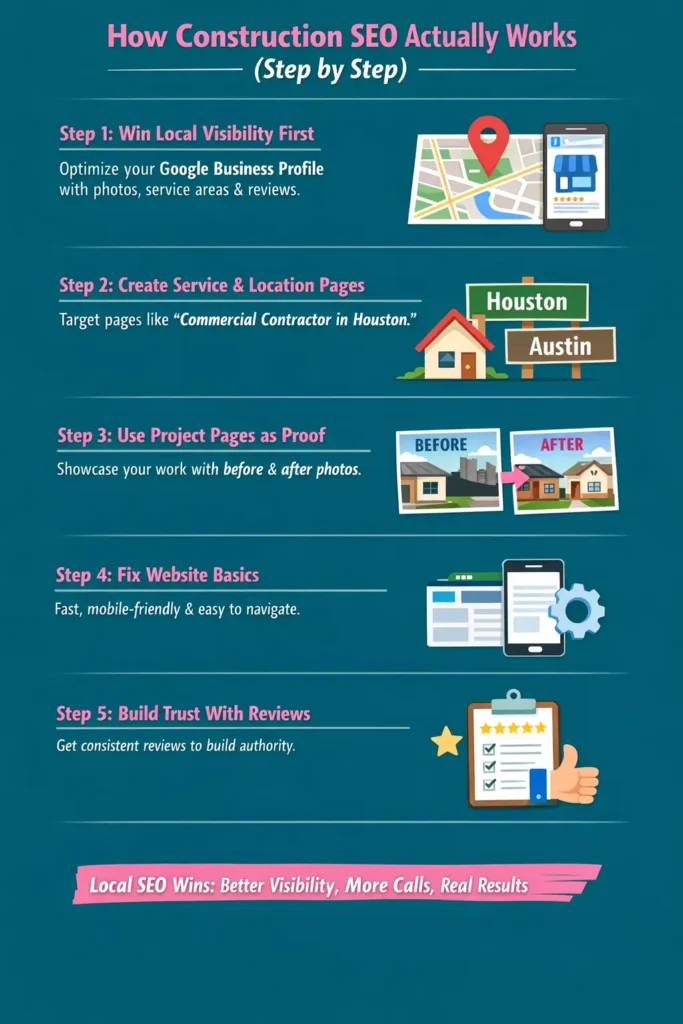
How Construction SEO Actually Works (Step by Step)
Step 1: Win Local Visibility First
Most construction leads start with a local search.
Your Google Business Profile often matters more than your homepage. Keeping it updated with real photos, service areas, and reviews improves visibility fast. Many contractors skip this step, even though it’s one of the easiest wins in local SEO.
If you haven’t reviewed yours recently, this local SEO audit guide explains what to check.
Step 2: Create Service and Location Pages That Make Sense
Instead of one generic services page, construction SEO works best when services are paired with locations.
Examples:
- Commercial contractor in Houston
- Home renovation in Austin
This structure is also used successfully in other service niches like SEO for landscapers, where location-specific intent drives calls.
Step 3: Use Project Pages as Proof, Not Decoration
Project pages are one of the most overlooked SEO assets in construction.
People don’t hire contractors based on promises. They hire based on proof. Project pages consistently keep visitors engaged longer because they answer the real question: “Have you done this before?”
Each project page should include:
- Location
- Scope of work
- Timeline
- Before-and-after photos
- Plain-language explanation
Step 4: Fix the Website Basics (Without Overthinking It)
You don’t need a flashy website. You need one that works.
Focus on:
- Fast load speed
- Mobile usability
- Clear navigation
- Simple contact paths
If you want to go deeper, this guide on user experience and SEO explains why usability directly affects rankings and conversions.
Step 5: Build Trust Through Reviews and Authority
Reviews influence both rankings and decisions.
Consistent reviews, accurate listings, and mentions from industry directories build long-term trust. This is where Google E-E-A-T signals come into play—experience, expertise, authority, and trust.
For a simple explanation of how Google evaluates trust, see this breakdown of Google E-E-A-T.
Common Construction SEO Mistakes to Avoid
Most construction SEO failures are not technical.
Common mistakes include:
- Relying only on blogs
- Ignoring project pages
- Targeting areas you don’t serve
- Over-optimizing keywords
- Neglecting reviews
We’ve seen companies improve rankings but still get no calls because their site lacked proof. Once project content and reviews were added, conversions followed—even without ranking jumps.
How Long Construction SEO Takes (And What’s Realistic)
Construction SEO takes time.
Despite promises online, real results usually show between three to six months. Faster wins happen only when a company already has strong reviews and offline reputation.
Early signs of success include:
- Better map visibility
- More calls
- Higher-quality inquiries
Traffic growth often comes later.
Pro Tip
Publish one real project page every month.
Over time, these pages become your strongest trust and ranking assets.
Expert Insight
For contractors, SEO works when it reflects how people actually choose builders—by seeing real work and real reviews. Rankings follow trust, not the other way around.
— Mike Ramsey, Founder of Niche Inbound
Build Trust First. Rankings Follow Naturally.
Construction SEO is not about tricks or shortcuts. It’s about being visible, local, and believable. When customers can see your work and trust your reputation, calls happen naturally.
Start with local SEO. Show real projects. Be consistent. If you want steady leads instead of guesswork, construction SEO is one of the most reliable long-term investments you can make.
Frequently Asked Questions
What is construction SEO used for?
Construction SEO helps contractors appear in local searches and turn online visibility into phone calls and quote requests.
How much does construction SEO usually cost?
Costs vary by competition and service areas. Most contractors invest monthly for steady, long-term growth.
Is construction SEO better than paid ads?
SEO builds long-term visibility. Paid ads stop when budgets end, but SEO keeps working over time.
Sources:
Moz (2024) – Local SEO Ranking Factors and Best Practices
https://moz.com/learn/seo/local
Google Search Central (2024) – How Google Understands and Ranks Content
https://developers.google.com/search/docs